

Dell and Nokia enlisted Intel and its Xeon 6 processors to power edge-based UPF (user plane function) devices to power distributed networks.
The device, initially teased at this year's Mobile World Congress (MWC) event, is designed to bring compute capabilities to the far edge via a low-footprint solution. Network operators can employ the UPF system to provide extra muscle when handling user data traffic in 5G networks.
The trio-developed device is due to be available during the second half of this year, and is touted to power compute workloads across distributed environments like industrial settings, remote sites, and suburbs.
Dell already makes use of Intel’s Xeon 6 processors in high-performance compute (HPC) sleds for distributed deployments – like the PowerEdge XR8720t, which supports up to 72 cores – with Dell claiming it offers more than two-times performance over the prior XR models.
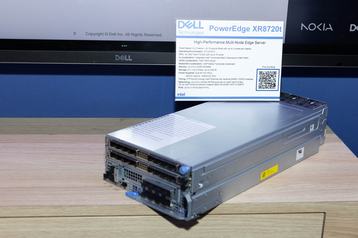
Nokia’s involvement will see its software solutions, including NFVi (NFV infrastructure) 5G Cloud Core and Cloud Mobility Manager, run on the UPF, helping to optimize workloads running on the device to reduce CPU power consumption by as much as 43%.
The trio contends their convergence will help telecom providers meet user performance and latency targets while scaling capacity to handle rising traffic burdens.
“As AI accelerates the transformation of mobile communications and changes how data flows through the network, we are helping our customers rearchitect their networks while balancing power and performance needs without the complexity of rip-and-replace upgrades,” Chandresh Ruparell, GM of Intel’s wireline and core network division, explained.
For Intel, the partnership marks another much-needed win for its processor line amid fierce competition. AMD, Nvidia, and Arm are hot on its heels as industry demand shifts from graphic processing units (GPUs) to central processing units (CPUs).
The chip firm’s prior-generation Sapphire Rapids chips is featured in a number of 5G radio access network (RAN) systems, with Intel placing a strong focus on its processors to support telecom, edge, and virtualized radio access network (vRAN) deployments.
But, increased competition and a precarious position amid financial distress has seen Intel fighting for relevancy. CEO Lip-Bu Tan in recent weeks looks to have somewhat steadied the ship, owing to a renewed focus on tangible engineering efforts, and backing from Nvidia, SoftBank, and the U.S. government.
While not out of the woods, Intel has since secured a mammoth partnership with Google to provide its Xeon platform for several of the hyperscaler’s workload-optimized instances. It also joined Elon Musk’s $20 billion TeraFab project, with the company’s rejuvenation culminating in a stock price up 245% compared to this time last year.





Comments