

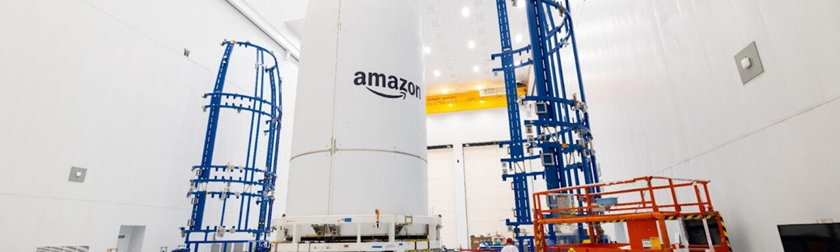
The Federal Communications Commission (FCC) agreed to review Amazon Leo’s application for its 5,105-satellite direct-to-device (D2D) low-Earth orbit (LEO) constellation, establishing a set of deadlines and petition periods for public comment. The service intends to start deploying in 2028.
"The bureau finds the application, upon initial review, to be acceptable for filing and seeks comment on the application and associated requests for waiver," the agency said in a statement.
The application proposes a fleet of D2D satellites orbiting at between 510 kilometers and 580 kilometers in altitude, across five orbital shells with a nominal operational lifetime of six to eight years, and with a policy of active de-orbiting at end of life. The proposed system will run service links in the 1.6 GHz and 2.4 GHz band, and telemetry, tracking, and command (TT&C), and feeder links in the Ka- and V-band. The company suggest the use of L- and S-band frequencies would be available to enable service links beyond the United States.
The constellation’s three mid-latitude orbital shells are intended for heavily-populated regions, while the two high-latitude shells will serve remote areas including the Polar regions.
Amazon Leo had previously announced partnerships with operators such as Vodafone, DirecTV, Herotel, and Australia’s National Broadband Network, and hopes to continue working closely with mobile network operators and other partners.
It reconfirmed that the satellite-based service would work with Apple devices including iPhones and Apple Watches, as well as integrating with Amazon Leo’s broadband service, that is intended to launch commercially later this year. The company’s proprietary D2D system has previously targeted in-vehicle connectivity and IoT applications.
Amazon recently moved to purchase satellite operator Globalstar for $11.57 billion, a deal that includes the company’s radio frequency spectrum. The deal is expected to close in 2027.
Preceding the deal, Apple purchased 20% of Globalstar for $400 million and paid $1.1 billion to expand iPhone satellite services with the company in November 2024, resulting in Apple occupying 85% of Globalstar’s network capacity. Amazon Leo remains committed to that deal.
Market commentators have previously predicted Amazon Leo (previously known as Project Kuiper) will seek to absorb market share through predatory pricing, the method that worked well for SpaceX's Starlink service.
It's a busy time for the satellite D2D market, with SpaceX declaring ambitious plans and telecom giants AT&T, T-Mobile US, and Verizon declaring an agreement in principle on a satellite joint venture.
More recently, legacy satellite operator and mobility specialists Lynk Global and Omnispace announced the completion of their merger, branding the combined company Elveo Mobile.





Comments