


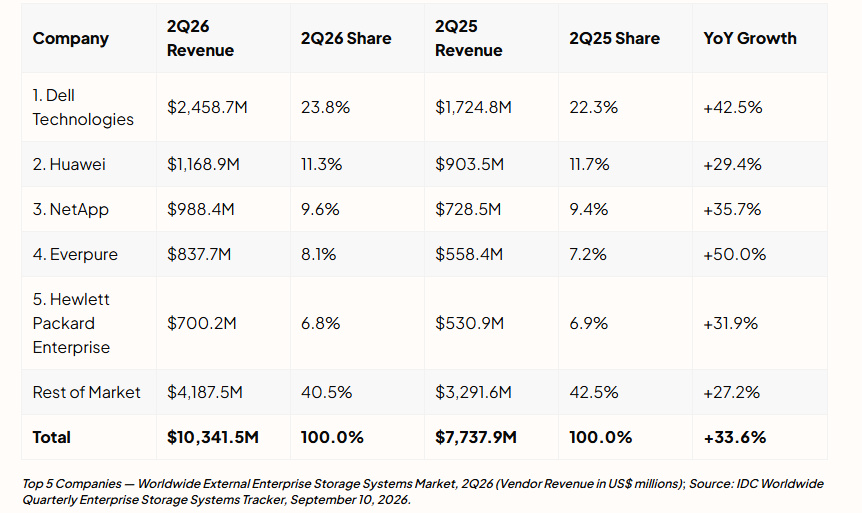
Enterprise storage demand continues to rise, jumping 33.6% year-over-year according to IDC’s latest quarterly report. The second quarter of 2026 marked the second-highest quarterly total in the tracker’s history, and the highest revenue ever recorded outside a fourth-quarter period.
Storage spending continues to rise as enterprise AI deployments require continuous data generation on top of a place to store it all. But the AI-induced memory wall – processor performance outpacing slower memory – means enterprises need more cache and more capacity.
But IDC’s tracker suggests that soaring component costs across all memory types, in combination with a multi-year infrastructure refresh cycle, are resulting in businesses buying less storage capacity but paying much more.
“Over the past two years, storage has taken a back seat to compute. Enterprises poured their budgets into accelerated server infrastructure to get AI training off the ground, and storage spending grew at a fraction of that pace,” Natalya Yezhkova, IDC’s VP for storage, data management, and enterprise infrastructure, said. “That balance is shifting. As AI moves from training to inferencing, the bottleneck isn’t just computing resources anymore; it’s how quickly and broadly organizations can put their data estates to work.”
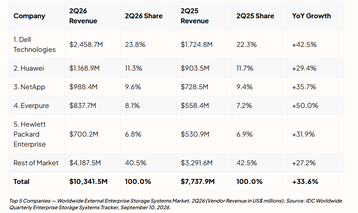
Vendor revenue for the quarter reached $10.3 billion, compared to just $7.7 billion in the same period last year. It was Dell that continued to lead the enterprise storage market, securing a 23.8% revenue share and 42.5% year-on-year (YoY) growth. Huawei followed closely behind with an 11.3% share, while NetApp placed third.
Everpure, the kings of flash, could only muster fourth place with an 8.1% share, but came out as the fastest-growing of any top-five vendor at +50.0% YoY, with IDC touting continued adoption of its subscription model. In fact, all-flash platforms built for GPU-to-storage bandwidth were among the fastest-growing product categories being tracked by the analyst giant.
Hewlett Packard Enterprise rounded out the top five with a 6.8% share and 31.9% growth.
In terms of geographical splits, the U.S. continued to be the dominant market for enterprise storage spending, while Canada was in fact the fastest-growing region. Markets including Latin America, the Middle East & Africa, and Europe all grew by double digits, while Japan was the market with the slowest storage growth.
“Storage systems are getting more expensive, and few customers have the luxury of waiting out the price cycle: the data must be accessible now. Those two forces together are what’s pushing the storage market back into growth,” Yezhkova said.
The analyst added that IDC expects component costs to remain elevated well into 2027, “keeping pricing-driven growth in place even as the market’s underlying demand signals from unstructured data growth to inferencing workloads to a deferred multi-year refresh cycle, continue to play out.


Comments