


Samsung Electronics has commenced shipments of samples of its upcoming 12-layer HBM4E (High Bandwidth Memory 4th Gen Enhanced) product line.
The offering, an apparent industry first in terms of the number of layers stacked on a 4‑nanometer logic die, marks the next-generation high bandwidth memory (HBM) line. Unlike rival DRAM offerings, which are stacked on a passive interposer, Samsung’s prospective product instead sees a thin silicon layer that routes signals between the memory and GPU.
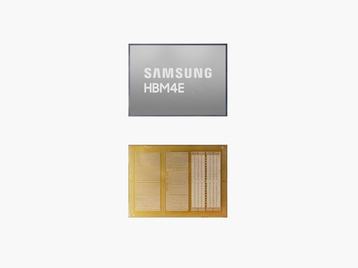
Aimed toward providing the underlying memory needs of AI computing and hyperscale infrastructure, Samsung claims HBM4E offers a stable pin speed of 14 gigabits per second (Gb/s), with performance scalable up to 16 Gb/s – a 20% increase over the prior generation HBM4, while enabling memory bandwidth of up to 3.6 terabits per second (TB/s) per stack.
Available in a 48-gigabyte (GB) capacity, the Korean giant claims the revised packaging structure improves energy efficiency by 16% and thermal resistance characteristics by more than 14% compared to the previous generation.
Having already received feedback from customers on its HBM4 line following initial production in February, Samsung said it plans to kickstart mass production for HBM4E “following initial sample shipments and optimization.”
“Following the successful mass production of HBM4, Samsung has once again demonstrated its distinct technological edge with HBM4E,” said Sang Joon Hwang, EVP and head of memory development at Samsung. “Through our advanced manufacturing capabilities and preemptive infrastructure investments, we will continue to drive the growth of the global AI memory market.”
Samsung has been riding the memory wave to record profits, taking full advantage of the increased demand for memory components from AI infrastructure builders to capture record profits.
One of the big three memory makers, Samsung has increased component prices amid soaring demand, while admitting it expects its HBM sales to more than triple in 2026.
The Korean firm won the race to supply Nvidia with its HBM4 for the upcoming Vera Rubin platform, having gone toe to toe with rival SK Hynix.
HBM4E was, in fact, revealed at GTC 2026, with Nvidia’s annual showcase coinciding with an agreement between the pair to collaborate on semiconductor engineering innovation spanning from R&D and design to manufacturing.






Comments