

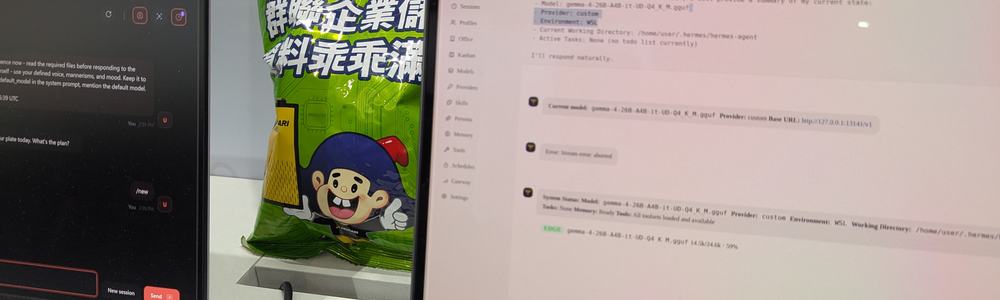
TAIPEI – Computex 2026 went off without a glitch, possibly thanks to coconut-flavored Kuai Kuai snacks. Whether things remain future-proof depends on the obedience of AI agents.
No, I'm not suffering from sunstroke (or am I?) You see, in techie circles, Taiwan is the home of Kuai Kuai culture, where a green-colored bag of Kuai Kuai corn puffs must be placed on a machine to keep it from malfunctioning. The characters in the brand's name (乖乖) are repeated for emphasis to mean "very well-behaved," and you need the coconut-flavored ones in their green bags for the magic to work.
Think it's crazy? Well, I spotted a packet of Kuai Kuai at the stand of non-volatile (NAND) memory vendor Phison Electronics, specifically nestled behind a pair of laptops running agentic claw systems. Their AI agents were running perfectly. But later, when I voyaged to see Nvidia run their NemoClaw system, it glitched out twice on two different operations that I've seen frontier models run like child's play in seconds.
And get this – there wasn't a bag of Kuai Kuai in sight at any of Nvidia's stands.
Got the chills? Perhaps you're thinking it's a coincidence. Well, I don't know about you, but with all this talk about the AI bubble, I think it may be time for Nvidia CEO Jensen Huang to order a giant installation of coconut treats for the rooftop of his U.S. headquarters.
Asia is booming
Arguably the whole talk of bubbles booming and bursting depends on the uptake of AI agents in the enterprise. This side of Asia is doing well from it; South Korea recently overtook the U.K. to become the world's eighth-largest stock market. Coinciding nicely with Computex, Taiwan this week surpassed India to become the world’s fifth-largest stock market.
Just prior to Computex, AMD announced a $10 billion-plus investment across the Taiwan ecosystem. Nvidia, meanwhile, promised to invest around $150 billion a year in the nation (but for how long was not clarified by Huang).
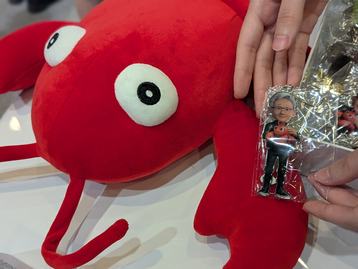
As such, there was a great upswell of optimism and energy on the Computex show floor – show floors, in fact, with the event spread across three venues in Taipei; four if you count the one exclusively used for Nvidia's GTC Taipei event, where I saw its agent capsize on its back like a moribund lobster in the Chez Paree.
In one of the TaiNEX halls, SDxCentral came across an advanced semiconductor packaging equipment vendor that was giving away artsy tote bags designed by a prominent modern-day pop artist who surely wasn't cheap to commission.
Looking further at their social media, the same company is selling branded beauty kits and Lego-style toy sets. That happy-go-lucky attitude was summed up by its spokesperson, who told me that claims of supply chain issues were exaggerated, and in fact, everything was going very well in the firm's home country of South Korea. They said there were no supply chain issues whatsoever! And South Korea doesn't even do the Kuai Kuai thing. How about that, eh?
Agents in Asia
If you follow all things agentic and also all things tech in Asia Pacific (APAC), you may have heard about OpenClaw going viral in China during the spring. That push was helped along by Tencent reportedly hosting around 1,000 everyday folk to install the agentic claw system on their laptops. Since then, China's telecom giants have become the first in the world to offer AI token packages for the mobile market, as I recently covered for SDxCentral.
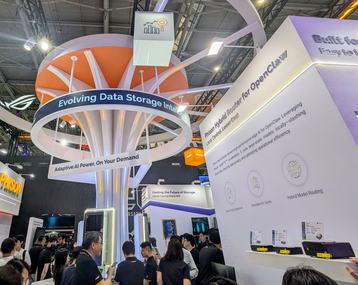
Computex 2026 was a good chance to see this apparent craze up close and see if the rest of APAC was taking the lead. Certainly, agents were talked up by everyone from Intel to AMD at the event. But looking across the stands, I rarely saw any lobster imagery.
It was lucky old Phison that took the lead with a stand proclaiming to offer hybrid routers equipped to handle OpenClaw deployments. Speaking with Rick Allen, product marketing lead for AI infrastructure at the Zhunan, Miaoli-headquartered firm, I learned how Phison recently partnered with Intel on a solution targeting agentic workloads. This collaboration hinges on an extended flash-memory-based technology from Phison designed to handle memory-gobbling agents.
"The problem that we're having with AI running locally is you need a lot of memory," Allen told me. "With flash storage, that becomes an additional memory tier for the AI."
Allen added that agents were popular enough in Taiwan – as they are in the U.S. where Phison also has major operations – for them to market their wares at Computex on claw-based popularity.
Seeing the laptops running Phison's tech, as powered by Intel Core Ultra Series 3 processors, it felt like the era of the AI PC had truly begun. It was only a few days before that Nvidia debuted its RTX Spark GPU/CPU hybrid chip for AI processing on Windows PCs. That release followed AMD's Ryzen AI Max PRO 400 Series launch for commercial AI PCs and original equipment manufacturer (OEM) systems.
With Phison on that list, it's easy to picture the personal AI future, and what that may mean for future networks.
Security and Jensanity
One thing missing from the Asian conversation on agents is security. This is a stark contrast from us regulated bores over in the Western Hemisphere.
The safety pitfalls of using systems like OpenClaw were barely mentioned at this year's Computex. But it is on vendors' minds from the hardware front that Computex is famous for; Rakesh Anigundi, AMD's director of product for Ryzen AI, told me safety all starts from hardware.
"On top of that, you need to build a software stack at an OS layer and also at an application layer," he said. "Security is going to become extremely key for all agentic deployments. ... I think things are going so fast, it's going to hit all of us faster than we think. That's why it's key to spend more time in architecting some of these agent [observation] technologies.
"The amount of variables that the security architecture software needs to come up to speed with in a short period of time is both scary and interesting," he added.
In other words, we need Kuai Kuai bags of security to keep these any disobedient agents in check; I believe Cisco compared them to hormonal teenagers at a recent event.
But whether Taiwan is jumping headfirst into agents is hard to tell. That's because the agentic craze is difficult to discern from the now-yearly phenomenon of Jensen-mania in Taipei.
Every time Jensen Huang comes to Taiwan, Jensanity ensues. They love their local hero. The queues I saw for the Nemoclaw experience were only long because of his star power. It's very possible that much more than a thousand people came to Nvidia's GTC Taipei event to try out Jensen's lobsters.
But it didn't happen for anyone else, and it wouldn't have happened if Nvidia had another person in the top role. They go nuts for him (or should I say coconuts?)
I guess my main takeaway is that agents have become popular this year due to open-source architectures like OpenClaw and Hermes, and the star platform of Nvidia.
This means agents are slowly trickling into enterprises; just as users got used to ChatGPT and wanted some of that in their work environment, agents will finally have their day on a business scale.
Which is extra ironic considering how many years now that vendors have been pushing their own proprietary agents to enterprises, putting the cart before the horse. All that marketing money and development, and in the end, it took a developer like Peter Steinberger to make agents finally go viral with zero promotion budget.
Only time will tell if that trend is enough to keep the Asian mini-boom afloat and the AI bubble from bursting. If everything depends on agents, then everybody needs to be using agents for all that investment – including in network expansion – to be worth it.
Perhaps then it shouldn't just be Nvidia that needs giant Kuai Kuai installations on top of their headquarters.






Comments