


China Mobile is the latest Chinese operator to offer up AI token packages for the mobile market.
According to CGTN, China Mobile is offering 400,000 tokens for 1 yuan through a partnership with Tencent, with payments also eligible through mobile billing.
Another report from Xinhuanet claimed the firm's operations in Jiangsu province offers a region-specific lite package of 2.5 million tokens for 5 yuan (around $0.73), and 20 million tokens for 40 yuan (about $5.88) in its premium package.
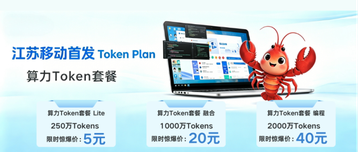
With its new packages, China Mobile joins other operators in offering AI token services, a phenomenon seemingly limited to China thus far.
According to the CGTN report, China Unicom offers around 6 million tokens for 15 yuan (around $2.20) at entry level, with higher tiers for enterprise customers.
China Telecom charges 9.9 yuan (about $1.46) per month for 10 million tokens with its economy package, and 49.9 yuan (around $7.34) per month with 80 million tokens per month in its premium tier, which was said to be designed for inference-heavy multi-agent collaboration.
China: living the MWC dream?
A recent SDxCentral interview with telecom vendor Huawei revealed China Mobile and China Telecom are piloting “AI plus home broadband” offers, e.g., elderly‑care services that detect if an older person has fallen by accident using camera-based computer vision plus connectivity. These are sold as value‑added home services, often powered by partner applications from the likes of Tencent.
In essence, Chinese operators seem to be living a business-to-consumer (B2C) version of the AI dream projected at this year's Mobile World Congress (MWC) event. As noted by this title at the event, operators were encouraged to build out the infrastructure for AI "tokenomics" to become a reality. This business-to-business (B2B) vision entails fiber routes, metro data centers, edge facilities, mobile core deployments, and private 5G networks powering the AI inferencing needed to power AI agents, chatbots, and robots.
From a European standpoint, Simon Dumbleton, European CTO for World Wide Technology (WWT), a system integrator known for its work in telecom cloud deployments, claimed this year's MWC showed "more real, tangible use cases from our infrastructure partners about how to leverage AI to accelerate outcomes."
Aaron Boasman-Patel, VP of innovation at TM Forum, gave the global scope by claiming China is leading the way in the "telco to techco" evolution, citing China Mobile as "playing a huge, huge role" on this front. Boasman-Patel added that the Chinese ecosystem more broadly – from China Telecom and ZTE in their edge AI efforts to cloud players like Baidu – is positioned to push hard into autonomous networks and AI‑driven services.
On the everyday consumer front, Matt Walker, founder and chief analyst at MTN Consulting, believe the ecosystem's current push on token packages demystifies the economics behind AI, with the potential to accelerate commercial adoption.
“One factor that restrains the commercial development of LLMs (large language models) is the opacity of token pricing," Walker contends. "It's hard to grasp, and users get frustrated with having to game the system to keep usage down. If Chinese telcos can help to standardize consumer understanding of what a token is, this would be promising for AI's development, and for the potential for telcos to get into this market.”






Comments