

If humanity can travel to the far side of the moon, then surely the long-awaited arrival of 6G is just around the corner?
The two concepts may seem unrelated until you talk to Satoshi Nagata. At this year’s Mobile World Congress (MWC) event, which happened a little bit before Artemis II's historic voyage, NTT DoCoMo’s senior manager for the Japanese operator’s 6G-Tech Department gave SDxCentral a unique insight into the 6G state of play in Japan and beyond.
As Nagata explained, DoCoMo thinks of future mobile infrastructure in three-dimensional terms. Where previously this two‑dimensional architecture was made up of base stations based on terra firma, where people live, work, and play, 6G pushes the model into a new dimension supported by geostationary Earth orbit (GEO) and low-Earth orbit (LEO) satellites, pushing connectivity beyond towers and rooftops.
“It's a three-dimensional network. We call our current network a horizontal network,” Nagata explained. “But with 6G, we have LEO and GEO. This network in the sky connects to the ground, to the horizontal network. But this is just the initial phase of the thinking. What is the actual definition of a three-dimensional network?"

In the network of the future, GEO must remain important as LEO is “not sufficient," in Nagata’s view. The exec added that Japan has a long history regarding GEO, with the technology supporting the nation in times of disaster.
“DoCoMo has a GEO service named Widestar. It's for emergency cases; some in the government have a GEO-based phone, so if the base station is destroyed in a disaster, the government will use the GEO service," Nagata explained.
LEO may not be as reliable in such situations, a view also shared by Spanish telecom infrastructure giant Cellnex, where it detailed its network backbone for security and emergency services across Catalonia.
Not that DoCoMo only sees GEO as useful for emergencies; Nagata notes its potential use in IoT cases, as well as in supporting agriculture and fishing operations across rural areas.
From robotic snails to Nintendo mushrooms
For DoCoMo, 6G is AI-native as it is space-native. But just as satellite operators and terrestrial carriers don’t move in lockstep, neither do AI and mobile generations.
"AI is a totally independent technology compared to 6G when it comes to speed,” Nagata reminded this title. “Who could have imagined the 2026 version of generative AI? So AI is dramatically changing our world, and I cannot imagine how much its speed will keep changing it.”
This makes dating the arrival of 6G more difficult, as AI will ultimately dictate when the market needs the tech, especially considering both the increasing impact of AI on today’s network traffic, alongside the rise of the robots.
On the first point, Nagata referred to artificial general intelligence (AGI) and artificial superintelligence (ASI), predicting AI will create traffic alone without human intervention, thus requiring the capacity promised by 6G.
This great unknown also extends to the increasing physical AI use case. This year's MWC conference was besieged by robots, with telecom operators looking in prime position to profit from the inference needed to power tomorrow's automatons both on Earth and even in space.
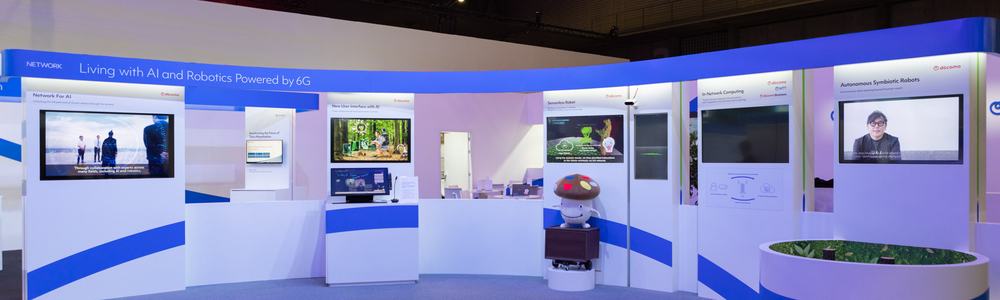
In one of the few examples of a telecom operator dabbling in robotics, NTT DoCoMo itself had some robot examples in the form of Docomodake, which used computer vision to track visitors to the brand’s booth. This mushroom, or “dake” cosplaying robot, was modeled after the NTT DoCoMo mascot (said mascot was once, rather intriguingly, given its own Nintendo DS game back in the 2000s). Docomodake was accompanied by Denden, a robot in the form of a snail designed to infiltrate animal environments, and was named after the colloquial Japanese term for the gastropod bug.
On the subject of robots, Nagata encouraged a little out-of-the-box thinking, imagining 6G powering the devices of tomorrow that robots will need, as opposed to the 4G- and 5G-powered devices used by today’s humans. In other words, 6G will underpin devices we cannot imagine until we realize what to equip tomorrow's robots with to carry out their daily operations.
The exec used the example of a house in which everything inside it, from rooms to furniture to stairs, is shaped around human bodies and habits. The current horizontal telecom network, in this analogy, is similar, being optimized for where humans live and move.
"But if nobody exists in my house, we might need to change the ways we design a house, especially when concerning robotics or human-robot coexistence.
“This kind of mindset change might affect every industry, like the car industry or medical industry," Nagata added. "To optimize for AI-driven robots, then everything from the device to the UI, UX will have to change."




Comments