


Isambard-AI, the fastest supercomputer in the U.K., was officially inaugurated this week, with the £225 million ($300 million) system set to power research across the country.
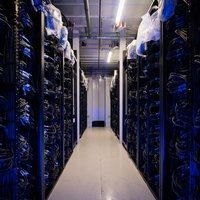
The system, which entered the latest Top 500 list at No. 11, is housed in the Bristol Centre for Supercomputing (BriCS), some 110 miles southwest of London.
Built on Hewlett Packard Enterprise (HPE) Cray’s EX supercomputer platform and powered by more than 5,000 Nvidia GH200 Grace Hopper Superchips, Isambard-AI has more computing power than all other U.K. supercomputers combined.
It boasts internal networking speeds of 200 Gb/s, some 2,000-times faster than the average U.K. home broadband speed, and brings the country’s compute capacity to 23 exaflops.
Peter Kyle, the U.K.’s science and technology minister, said the supercomputer “propels the U.K. to the forefront of AI discovery.”
“With our AI Research Resource now fully up and running, the U.K. is home to the raw computational horsepower that will save lives, create jobs, and help us reach net-zero ambitions faster," Kyle added.
The project first got the green light in September 2023 under the previous Conservative government, with phase one of the supercomputing having come online in May.
Named after Isambard Kingdom Brunel, the engineer who designed much of the railways and projects that powered the Industrial Revolution, the supercomputer will work alongside the University of Cambridge’s Dawn to support AI research.
A third system that would have been built at the University of Edinburgh and the AI Research Resource was among the Tory-era plans scrapped by the Labour government last August.
Researchers at the University of Bristol are already using Isambard-AI to analyze MRI scans for potential cancer cases and recordings from smart wearables to help potential dementia patients perform tasks at home.
Ooh arr, let’s get technical
Isambard-AI is built on the HPE Cray EX supercomputing platform, which also powers the Frontier supercomputer.
Unlike that system, which features AMD hardware, Isambard-AI houses 5,448 Nvidia GH200 Grace Hopper Superchips that combine an Arm-based Grace CPU with a Hopper-based GPU to power intense AI workloads.
There are 440 direct liquid-cooling GPUs per cabinet, with Isambard-AI featuring nearly 25 petabytes of storage through its Cray Clusterstor E1000, which is specifically optimized for AI workflows.
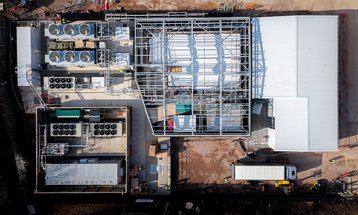
The entire unit uses HPE’s 100% fanless, direct liquid-cooling technology to improve energy efficiency, with the supercomputer housed in a self-cooled, self-contained data center via HPE’s Performance Optimized Data Center (POD) system.
The system’s modular design helped to slash build time from four to five years to just under two.
Isambard-AI is also one of the greenest supercomputers in the world, with the latest Green500 list ranking it No. 4.
“Due to its impressive power, working at speeds 100,000-times faster than an average laptop, we will soon see Isambard AI deliver transformational research and breakthroughs that will ultimately improve people’s lives," Evelyn Welch, vice chancellor and president of the University of Bristol, added.
Inside Isambard-AI's network
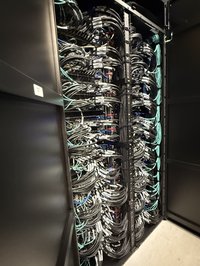
Connecting the 5,448 GPUs is HPE’s Slingshot 11 interconnect system.
The Ethernet-based offering provides 25.6 Tb/s of bi-directional bandwidth across 64 ports, each capable of 200 Gb.
Slingshot 11 is the same high-performance interconnect found in Frontier, but that brings together hardware from Nvidia's big rival, AMD.
Nvidia networking offerings have traditionally utilized InfiniBand, not Ethernet, for AI back-end scale-up. The world's first $4 trillion firm has stepped up its use of the standard in recent years, with recent Dell’Oro Group research suggesting Ethernet to surpass InfiniBand for AI in workloads in the next few years.
Neil MacDonald, EVP and general manager of HPE's server business, told SDxCentral the decision to leverage an Ethernet-based interconnect came from providing the best "system-level experience" for Isambard-AI users.
"The largest systems in the world will require capabilities in the network that traditionally you don't get from Ethernet. Ethernet doesn't historically perform well under load. It doesn't perform consistently. It's not designed for the highest performance.
"With the innovations in Slingshot and other Ethernet-based technologies, Ethernet is becoming very, very compelling as a platform for building some of these systems, and we expect to see that continuing, but we also expect to see InfiniBand continue as a technology for certain use cases."





Comments