

AI has a growing memory problem. Google thinks it's found the answer, and it doesn't require more or better hardware.
Originally detailed in an April 2025 paper, TurboQuant is an advanced compression algorithm that’s going viral over claims it can reduce key value memory by “at least 6x.”
What is TurboQuant?
TurboQuant is part of Google’s efforts to create an algorithm capable of reducing the memory footprint of AI systems by compressing the key-value (KV) cache – a process technically known as KV cache quantization.
Per the original paper, it’s designed to be lightweight to ensure it’s suitable for use supporting online applications, and also “highly accelerator-friendly.”
“The core of TurboQuant is a two-stage process,” the paper reads. “First, we develop a vector quantizer with optimal distortion rate in terms of mean-squared error (MSE). Subsequently, we apply a one-bit quantizer to the residual, resulting in an unbiased and low-distortion inner product quantizer.”
For those who don’t speak technical, TurboQuant essentially compresses AI models while maintaining their core makeup, without the need for preprocessing or specific calibration data.
Practically speaking, Google’s concept could reduce key-value bottlenecks without sacrificing model performance.
A blog post outlining the algorithm, published ahead of it being presented at ICLR 2026 in Brazil, said it has “potentially profound implications for all compression-reliant use cases, including and especially in the domains of search and AI.”
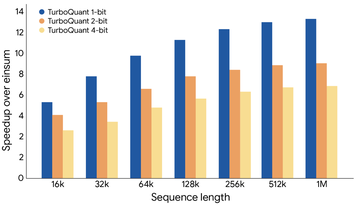
Beyond KV cache compression, the initial paper demonstrates its use in vector databases for semantic search. But the potential applications for AI were the real reason this compression algorithm, of all things, has gone viral.
The ever-worsening memory shortage has seen developers come up with innovative ways to beat or at least cope with the crunch, be it higher network utilization, compute express link (CXL) interconnects, or hybrid memory architectures.
But some are positioning TurboQuant as a "keep calm and carry on" alternative, with AI model developers potentially able to minimize KV memory footprints.
Among those racing to praise TurboQuant was Cloudflare CEO Matthew Prince, who boldly declared the release was “Google’s DeepSeek.”
“So much more room to optimize AI inference for speed, memory usage, power consumption, and multitenant utilization,” he said in a post on X. “Lots of teams at Cloudflare focused on these areas. Stay tuned.”
Meanwhile, memory makers like Micron and Sandisk have seen stock price dips, with Shay Boloor from Futurum’s Equities Research division, claiming: “The market is reading it as a potential headwind for memory names because long-context AI inference may now need far less memory per workload.”
Speculation about TurboQuant may well have impacted SanDisk, though more likely that stock dip stems from its announcement of plans to invest $1 billion in Taiwanese dynamic random access memory (DRAM) manufacturer Nanya Technology.
For Micron, meanwhile, investors have just been reacting to its latest earnings announcement where, despite posting another record quarter, its stock has oftentimes been unpredictably volatile.
For Google researchers behind TurboQuant, its value is twofold: “While a major application is solving the key-value cache bottleneck in models like Gemini, the impact of efficient, online vector quantization extends even further,” the company blog post reads.
“For example, modern search is evolving beyond just keywords to understand intent and meaning. This requires vector search – the ability to find the nearest or most semantically similar items in a database of billions of vectors," the post continues. “Techniques like TurboQuant are critical for this mission. They allow for building and querying large vector indices with minimal memory, near-zero preprocessing time, and state-of-the-art accuracy. This makes semantic search at Google's scale faster and more efficient. As AI becomes more integrated into all products, from large language models (LLMs) to semantic search, this work in fundamental vector quantization will be more critical than ever.”






Comments