

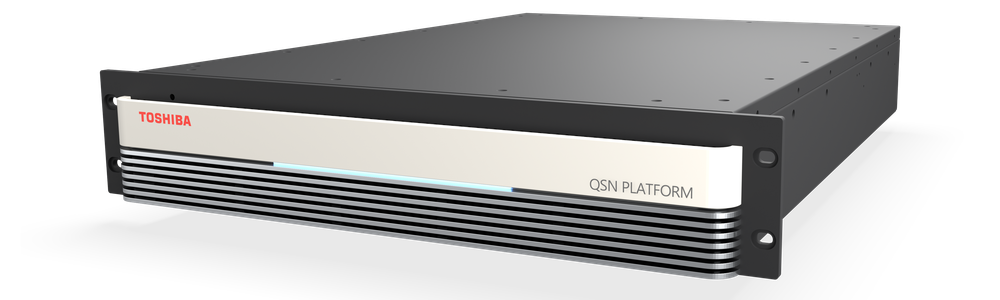
Toshiba has introduced a quantum-safe networking platform designed to reduce the equipment operators need to connect multiple customer sites.
The Quantum-Safe Networking (QSN) Platform combines quantum key distribution (QKD) technologies, key delivery and management software, and centralized network control. Toshiba says operators can start with individual connections and expand into larger networks using existing infrastructure.
Andrew Shields, vice president of Toshiba Europe and head of its Quantum Technology Division, told SDxCentral that all platform components are available now, and Toshiba plans to work with partners to migrate customers from its earlier technology.

Sharing equipment across sites
Toshiba’s existing products primarily support point-to-point QKD links. The new platform adds transceivers, hubs, spokes, and optical switching to support more flexible network configurations.
Lee Johnson, Toshiba’s QSN Platform lead, described a conventional deployment connecting a data center to 100 customers as requiring 100 central-site boxes, paired with another 100 in the field.
A QSN Hub uses optical switching to connect shared central equipment to multiple remote endpoints.
“It dramatically reduces the cost, size, weight, and power required in your central DC,” Johnson said.
The hub switches capacity between sites, predominantly on a time basis, although customers can define how it is allocated. The connections therefore share the hub’s capacity rather than each receiving a dedicated central unit.
According to Toshiba’s announcement, a hub can serve hundreds of remote sites. Johnson explained that capacity depends on the optical switch configuration.
Existing fiber, hybrid keys
The platform supports coexistence with conventional data services on existing fiber, removing the requirement for dedicated dark fiber, according to Toshiba. Operators can still use dedicated fiber where preferred.
Its multiplexer allows quantum and QKD service channels to share existing fiber with conventional data traffic carried over dense wavelength-division multiplexing (DWDM) systems. Transceivers combine quantum transmitters and receivers in one chassis, while a controller provides centralized configuration and software-defined networking interfaces.
Johnson said the platform supports key-delivery interface standards set by the European Telecommunications Standards Institute (ETSI) for encryptors, applications, and management systems, alongside Simple Network Management Protocol (SNMP) for operator management information.
The key delivery system can distribute QKD-derived keys, keys established using post-quantum cryptography (PQC), or hybrid keys combining both approaches. A separate key management system runs on standard x86 servers.
“Both of them together provide a defense-in-depth approach,” Johnson said.
The launch targets network operators, data center providers, enterprises, and public-sector organizations. Supported configurations range from dedicated point-to-point connections to hub-and-spoke, ring, mesh, and long-distance networks.
Shields said the aim is to let operators deploy the platform throughout their networks, extending beyond the small-scale deployments supported by Toshiba’s previous technology.






Comments