


Researchers at Michigan State University demonstrated a nickel-vacancy (NiV⁻) qubit with more than a millisecond of coherence under all-optical control. The study suggests that the diamond-based platform could overcome longstanding trade-offs in spin-photon interfaces for quantum networking.
Published on arXiv, the work positions transition-metal defects as an alternative to more widely studied nitrogen-vacancy (NV) and silicon-vacancy (SiV) color centers, combining long-lived quantum memory, optical control, and near-infrared photon emission.
Quantum networking requires qubits capable of storing information while efficiently exchanging photons between network nodes. Existing diamond color centers have shown promise but typically require trade-offs between coherence time, optical performance, and scalability.
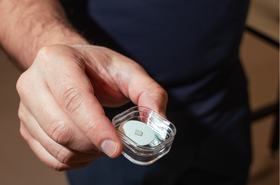
Cutting-edge compute: Could diamonds bring quantum out of the freezer?
The imperfect diamond that could make room-temperature computing quantum's best friend
The MSU team extended the coherence time of a single NiV⁻ defect from 371 nanoseconds to 1.27 milliseconds using all-optical dynamical decoupling. They also demonstrated Raman Rabi oscillations and Ramsey interferometry, enabling the qubit to be manipulated and read out entirely with optical pulses.
Unlike many quantum hardware platforms, the device operated at 1.65 Kelvin, a temperature compatible with compact closed-cycle cryocoolers rather than dilution refrigerators. According to the researchers, the nickel-vacancy defect combines spin-orbit-protected ground-state coherence with near-infrared photon emission, potentially making it well suited to future distributed quantum computing and quantum networking architectures.
The demonstration addresses a longstanding challenge in diamond-based quantum hardware: combining efficient optical interfaces with sufficiently long coherence times to support practical quantum memories and networked quantum systems.
The researchers cautioned that significant work remains before the platform could be deployed in large-scale systems. The study involved a single nickel-vacancy defect operating under cryogenic conditions, while further improvements in material purity and isotopic engineering would be needed to approach the approximately 30-millisecond coherence times predicted by theory.
Future work will focus on reliably creating and controlling multiple nickel-vacancy defects, a necessary step toward scalable quantum devices and networked quantum systems.
The paper adds another contender to the growing range of solid-state qubit technologies being explored for quantum networking, where researchers continue to seek scalable hardware that combines long-lived quantum memory with efficient optical communication between network nodes.




Comments