


A lot is expected to happen in the year 2029: Apophis, a 1,480-foot asteroid, is expected to pass by Earth at a distance of some 20,000 miles; NASA’s New Horizons spacecraft is expected to leave the solar system; And the PlayStation 6 is rumored to drop, having been pushed back after earlier 2027 speculation.
But, 2029 is also the year Google predicts we will finally achieve a quantum breakthrough: "Q-day." Constant cries of "coming soon" or "next year" have seen a quantum become the perennial nearly man.
While quantum has been held back by everything from immense development costs, error correction conundrums, high error rates, and the sheer complexity of it all, one major headache ties these all together: refrigeration.
Dilution refrigerators can cost millions of dollars, instantly pricing out all but the wealthiest labs. And even if you have the cash, scaling up to fix high error rates creates a thermal trap as every additional qubit adds a new heat signature that could well threaten to overwhelm the cooling system. Ultimately, engineers are forced to cram miles of intricate control wiring into a vacuum-sealed thermos the size of a van, where even a single thermal leak can ruin weeks of computation.
While heat plus a lack of cash and a whole lot of complexity has long been the enemy of coherence in the quantum realm, one firm is looking to change that. Instead of vast, van-sized cathedrals to compute you might see from the likes of IBM or Google, Australian-German firm Quantum Brilliance wants to take the technology and make it applicable at room temperature.

The Quantum Supplement
The cryptographic race against quantum decryption
A gem of an idea
The startup’s central idea to bring quantum computing to room temperature is even more outlandish than quantum itself: diamonds.
The core idea of Quantum Brilliance is to exploit the nitrogen-vacancy (NV) center in diamonds. These are literal imperfections in an otherwise perfect crystal lattice.
To save your headache, since diamond is made of incredibly strong carbon bonds, it acts as what is essentially a rigid shield for these defects. By swapping a carbon atom for a nitrogen atom sitting next to an empty hole (or a vacancy), they create a stable environment where quantum bits – better known as qubits – can survive and interact at room temperature, thus eliminating the need for massive, sub-zero refrigerators.
The startup isn’t plundering the diamond mines of Botswana or Angola to make this a reality, for those worrying about the costs of a diamond quantum computer. Instead, they rely on synthetic diamonds as the host material.
“There is a supply chain that provides synthetic diamonds. It’s not a very massive volume yet, but there are suppliers globally readily available,” Andrea Tabacchini, Quantum Brilliance’s VP of product and marketing, explained. “We procure these substrates, then functionalize them for quantum. And out of it, we build the chip, which is the final product. But volume isn’t an issue because our diamonds are really small.”

Precedence Research projects the global lab-grown diamond market to be valued at $108.98 billion by 2035, compared to just $29.73 billion in 2025. And while eco-friendly alternatives to natural diamonds like those made by Skydiamond are seen as a large driver of that demand, the team at Quantum Brilliance has other ideas.
“The lab-grown diamond market for gemstones is more mature and has been around for probably 15, 20 years,” COO Andrew Dunn explained. “When it began, gemstones were about $20,000 a carat. They're now about $100 a carat. That's the production cost. So we'll see something similar in quantum.
“At the moment, quantum-degraded diamond is a few thousand dollars for a piece of diamond that we use, so I'd see that cost coming down pretty quickly as volumes ramp up," Dunn added.
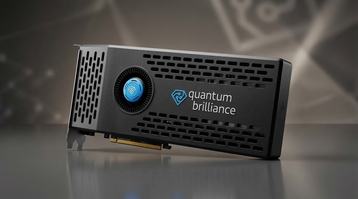
A few thousand dollars, or a minimum of hundreds-of-thousands of dollars, just for a fridge to keep your already exorbitant quantum computer cool? It’s easy to get lost in the heady cost savings claims alone. But then comes the potential for form factor, with Quantum Brilliance showing a mockup of what the technology could look like in the form of a graphics processing unit (GPU) circa late 2010s.
“So the product is going to go into production in several years, it’s going to look much different,” Tabacchini said. “But the reason why we went for the GPU look is that, when the vision was forged six years ago, when the company was founded in 2019, the idea was, we want to build a quantum computer that looks like a GPU. And this is exactly how GPUs looked back then. Then they do not look like this anymore. It could end up being just a chip that you install on your own printed circuit board (PCB). It could be a PCB embedded in a larger board.”
EVs and emulators: The path to mass parallelization
While production is “several years” away, how far along is this vision of quantum at room temperature via diamonds? The Quantum Brilliance team is already pushing its room‑temperature vision into the real world.
The same NV‑center defects that act as qubits also make exceptionally sensitive magnetic field sensors. Tabacchini said the company is using quantum sensing to “fill the gap on the market between now and when the computer is going to be ready,” selling diamond‑based sensors while the computing stack matures.
They’ve also been making strides under the hood with Nvidia. Having joined the chip giant’s Inception program, Quantum Brilliance worked with its quantum team to develop high‑performance emulators and libraries that customers can use today to prototype hybrid quantum‑classical workloads, long before a room‑temperature diamond accelerator ships as a product.
Beyond emulations and sensing, though, the team has already deployed an early prototype in a car, of all places.
“There was a source of noise in the lab. And so the engineer decided to isolate where that source of noise was coming from. He would literally pick up and take the quantum computer outside. And so he took it to his electric vehicle, he plugged it into his EV, and turned it on, and the noise was not there,” Dunn recalled. “And so there was some noise source in the lamp.”
Just hundreds of watts were required to make the system run in that scenario, the team claimed. For comparison, QuEra’s 256-qubit Aquila quantum computer uses around 7,000 watts (7 kW) and is viewed as on the lower end of the power consumption spectrum.
“There are two ways of building a powerful, useful quantum computer,” Dunn explained. “One is to monolithically create more and more qubits on the same piece of silicon or diamond or whatever it is you are using. That's got some fundamental challenges for everybody, us included. The other way is to build smaller sub-units of quantum computers, and then you can either parallelize them classically or quantumly. I think that's a much more practical route to a useful quantum computer.
“The implication of that is you're going to need lots of quantum computers. And if you need lots of quantum computers, they need to be small, cheap, cheap to run, cheap to buy, and do the job required," Dunn continued. "Diamond is probably one of, perhaps the only route toward achieving a sort of mass parallelization of quantum compute.”






Comments