


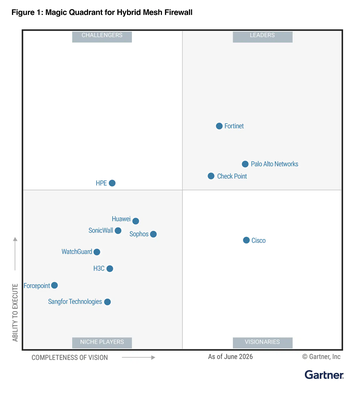
Fortinet, Palo Alto Networks, and Check Point were the only players to have earned a "leaders" spot in Gartner’s coveted Magic Quadrant for hybrid mesh firewalls (HMF).
Sunnyvale, California-based Fortinet was the highest-placed in the leaders category, with Gartner crowning the vendor top dog among enterprise perimeter, heavy branches, and data center use cases. Advanced SD-WAN orchestration through its FortiManager Cloud platform and strong innovation in AI-based automation were among the ticks the analyst firm found in its favor.
Gartner lauded Fortinet on its plans for a unified model context protocol (MCP) framework for AI agent-based automation as well as IoT and cyber-physical systems (CPS) device detection.
Second highest on the list was Palo Alto Networks, drawing plaudits for quantum-safe offerings and adaptive AI runtime security through its Prisma AIRS offering.
The Santa Clara, California-based vendor was also singled out for its product and feature set, with Gartner highlighting its built-in AI assistant for performing administrative tasks, and advanced threat detection and protection capabilities.
Rounding out the leadership trio was Tel Aviv, Israel-based Check Point, whose hybrid mesh firewall offerings specifically target AI data centers and neoclouds.
The last of the leaders was found to offer strong post-quantum cryptography (PQC) readiness, while Gartner also highlighted feature sets owing to Check Point’s Lakera AI acquisition, which saw protection for prompts, MCP, and application-to-application (A2A) communications added to its platform.
Gartner also applied the rare applause for Check Point being the first vendor to introduce firewall appliance consumption-based subscriptions, allowing clients to deploy firewalls without fixed commitments.
The list leaders weren’t without their cautions, though.
Gartner found Fortinet’s branding and marketing to be “heavily focused on edge and perimeter use cases,” resulting in the vendor not being on client shortlists for the cloud firewall use cases compared to direct competition. Surveyed clients also told the analyst firm of recent price increases and “unexpected high costs.”
Cost was also an issue cited against Palo Alto, with Gartner revealing clients “express frustration with higher total cost of ownership” and a failure to share list price. Smaller clients also cited an issue getting renewal quotations “because of their smaller deal size and receive limited support for quotation-related queries.”
Check Point, meanwhile, was not among vendors being shortlisted frequently for newer client deployments, the analyst firm revealed. Gartner attributed its absence to “a lack of strong security branding across network security and cloud security use cases.”
The vendor was also cited as being “slower to address emerging cloud use cases,” including containerized firewalls and dedicated microsegmentation, while also lacking advanced SD-WAN capabilities compared with direct competitors.
A field of one: visionaries and challengers
In what looks to be a lopsided Magic Quadrant, just a solitary brand each comprised the "challengers" and "visionaries" segments, with the rest finding themselves lumped together as "niche players."
Cisco was the sole visionary brand, with Gartner highlighting strong market understanding and a solid vision, a position bolstered by Cisco being one of only a few vendors to extend support to third-party firewalls.
Despite its technological process, Gartner found Cisco to have somewhat of a security identity problem, stating “cybersecurity leaders do not view Cisco as a security vendor for best-of-breed security use cases such as cloud firewall or microsegmentation.”
When it comes to market execution, the analyst firm said it does not see Cisco’s hybrid mesh firewall offering being frequently shortlisted for newer customer deployments. While disclosure of exploited vulnerabilities was cited as a concern by customers, some clients “continue to report issues related to bugs, unstable firmware, and frequent patching.”
The only challengers brand was Hewlett Packard Enterprise (HPE), which offers hybrid mesh firewall solutions via its Networking Security Director offering.
Gartner found the vendor “lacks a strong product strategy” for more advanced use cases such as microsegmentation for cloud environments, with HPE also found lacking when it comes to an integrated HMF and secure access service edge (SASE) offering for clients seeking a more platform-centric approach.
Product quality issues, reporting firmware-related bugs, lagging PQC support, and the inability of technical support to provide faster resolution were also cited by Gartner clients as reasons to shift away from HPE.
Niche players was a smorgasbord of vendors ranging from geography-locked entities like Huawei and Sangfor to the small business-focused Sophos and WatchGuard.
SonicWall and Forcepoint also found themselves in this segment, both getting dinged for lacking a strong HMF-specific product strategy.




Comments