


SoftBank developed a new base station antenna design aimed at reducing power consumption and simplifying deployment for future 6G networks.
The company said its “functional beam shaping lens antenna,” developed with AGC, can cut power consumption by up to one-eighth compared with conventional massive multiple-input, multiple-output (MIMO) systems while maintaining similar coverage and performance.
The design combines SoftBank’s antenna and coverage planning with AGC’s metasurface lens technology, which uses microstructured materials to shape radio waves without requiring complex electronic control.
As mobile data traffic continues to grow, operators are likely to rely more heavily on high-frequency spectrum to deliver higher capacity. But these bands suffer from limited coverage and higher propagation loss, increasing the need for dense base station deployments and more complex antenna systems.
Conventional massive MIMO antennas use beamforming in both horizontal and vertical directions to track users, requiring large numbers of control ICs and increasing power consumption, size, and cooling requirements.
SoftBank’s approach shifts much of the vertical beam shaping from electronic control to a physical lens, reducing the number of antenna elements and associated components. The company said this enables a reduction in power consumption of up to one-eighth and could also reduce the size and weight of heat sinks.
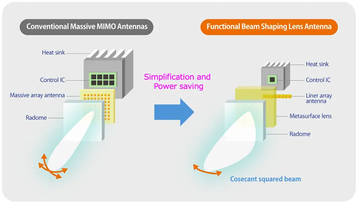
The system uses a fixed vertical “cosecant squared” beam pattern to maintain more consistent signal quality over distance, while horizontal beamforming remains dynamically controlled.
SoftBank tested the antenna in field trials in Tokyo using 5G signals in the 29.7 GHz spectrum band. The tests measured signal-to-noise ratio (SNR) and signal quality at varying distances between the base station and user equipment.
According to the company, the system maintained a stable SNR of 15 dB or higher across most test locations, with signal constellations showing clear, undistorted reception. The results suggest the antenna can deliver coverage and performance comparable to conventional massive MIMO systems.
SoftBank said the design could help reduce the cost and operational burden of deploying base stations in high-frequency bands, which stand to play a key role in 6G networks.
The company plans to continue development of the antenna with the aim of commercial deployment.






Comments