


A team of scientists at the University of Manchester created a molecule capable of remembering magnetic information at the highest temperature ever recorded, in what could prove a major boon for the future of data storage.
The findings, published in Nature, saw UK researchers join up with chemists from Australian National University (ANU) to create a new type of single-molecule magnet capable of retaining its magnetic memory up to 100 Kelvin (-173°C), smashing the previous record of 80 Kelvin (-193°C).
What does all this mean for data storage?
If the tech can be perfected, it could enable storage densities of more than three terabytes per square centimeter - that's about 100 times denser than current technology limits.
The team behind it likened it to being able to support half a million TikTok videos on a hard drive the size of a postage stamp, should you ever feel compelled to hoard that much fleeting social media content.
The molecule can store the magnetic information alone, without needing neighboring atoms to help maintain its memory. Current hard drives store data by magnetizing regions containing a host of atoms that work together to keep the information intact.
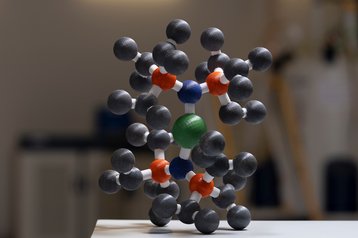
It does, however, use the element dysprosium positioned between two nitrogen atoms in an almost perfectly straight line, allowing each individual molecule to store information independently, which dramatically increases storage density.
Previous research into the concept saw the dysprosium-nitrogen molecular magnets bend out of shape, which impacted performance. But the team from Manchester solved this by adding an alkene group that acts like a molecular pin, holding the dysprosium in the optimal linear position between the nitrogen atoms.
David Mills, professor of inorganic chemistry at the University of Manchester, said: “This research showcases the power of chemists to deliberately design and build molecules with targeted properties.
“The results are an exciting prospect for the use of single-molecule magnets in data storage media that is 100 times more dense than the absolute limit of current technologies.”
While we won't see this in consumer devices anytime soon – as your phone would need some serious refrigeration – it could revolutionize how we store the massive amounts of data generated by cloud computing, AI, and other data-intensive applications.
Since liquid nitrogen is readily available as a coolant, achieving temperatures above its 77 Kelvin threshold could make this technology far more feasible.
“Although the new magnet still needs cooling far below room temperature, it is now well above the temperature of liquid nitrogen (77 Kelvin), which is a readily available coolant,” Mills added.
“While we won’t be seeing this type of data storage in our mobile phones for a while, it does make storing information in huge data centers more feasible.”





Comments