

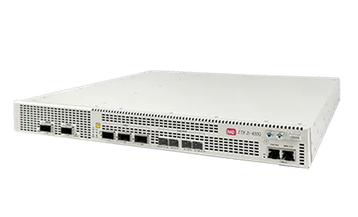
Networking equipment provider Rad joined the growing scramble to support data center scale-across connectivity with a new interconnect solution capable of shifting data efficiently between facilities.
The ETX-2i-400G is an Ethernet-based solution that enables high-throughput, low-latency transfer of large datasets between data centers.
The offering features multiple 400 Gb/s (400G) quad small form-factor pluggable "double density" (QSFP-DD) interfaces. These are ports utilizing eight high-speed electrical lanes to deliver the high-capacity throughput needed to support connections between disparate data centers while also providing backward compatibility with legacy QSFP modules.
Rad’s launch comes amid increasing industry realization about the sheer scale required to support AI projects.
Enter scale-across, or simply, extending capacity and connectivity between separate locations. Instead of building massive sites that require enormous quantities of equipment, power, and fiber – and permits to go with it – the idea instead sees data centers distributed across vast distances but working on workloads in tandem.
JLL projections suggest the explosive demand for AI infrastructure and the move from training to inference workloads over the next five years will result in an increased shift from centralized clusters to distributed edge and regional computing hubs.
Hyperscale players have naturally rushed ahead as the idea could seriously help stretch the enormous capex they’ve earmarked for data center buildout, with early examples like Amazon Web Services' (AWS) Project Rainer or Microsoft’s Fairwater showcase distributed, multisite infrastructure can work.
Rad’s ETX-2i-400G launch looks to take the concept and bring it to players beyond the hyperscale level, touting it as “ideal” for communication service providers (CSPs) wanting to deliver high-capacity, low-latency services.
Rad’s offering also allows for users to secure networks across distributed clusters against future threats via a security framework that includes support for quantum key distribution (QKD) and post‑quantum cryptography (PQC).
“Training AI models require moving massive datasets quickly and efficiently between data centers to ensure that expensive GPU resources never sit idle,” Eli Angel, VP of product and marketing at Rad, explained. “This is where our new solution comes in, enabling cost‑effective and secure transfer of large data streams between data centers.”




Comments