


Microsoft has offered a glimpse into the network architecture connecting hundreds of thousands of GPUs across its latest Fairwater AI data center, including a new custom networking protocol developed alongside OpenAI and Nvidia.
The mammoth site is located in Atlanta, Georgia, and is the hyperscaler’s second Fairwater facility following the creation of its Wisconsin site.
While no exact capacity details were shared, Microsoft revealed its Fairwater data centers are directly connected using a dedicated network that allows data to flow between the disparate sites.
“This is about building a distributed network that can act as a virtual supercomputer for tackling the world’s biggest challenges in ways that you just could not do in a single facility,” said Alistair Speirs, Microsoft’s general manager focusing on Azure infrastructure.
Each of Microsoft’s Fairwater facilities is connected with an AI-infused iteration of a Wide Area Network, which the hyperscaler christened AI WAN.
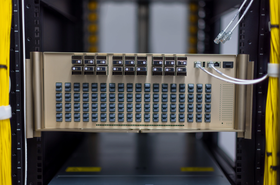
This technology connects individual chips and racks in one site to infrastructure at another facility via dedicated fiber-optic cables. Each site can fire data between one another, congestion-free at super-fast speeds. The company increased its overall fiber network mileage by more than 25% to support the project in just a year, bringing its total miles to around 120,000.
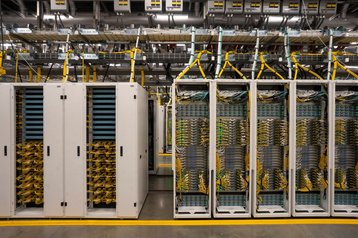
Powering the AI WAN is a networking protocol that the hyperscaler developed alongside OpenAI and Nvidia. Dubbed Multi-Path Reliable Connected (MRC), the protocol allows data sent from one Fairwater site to another using the most optimized route.
Originally outlined on a company blog post before being quietly removed, Microsoft said MRC offers improvements across packet trimming, packet spray, and high-frequency telemetry to “deliver advanced congestion control, rapid detection and retransmission and agile load balancing.”
SDxCentral has contacted Microsoft for further details.
“The future of AI will be shaped by connecting data centers into a unified, distributed system,” Guthrie said. “By making our AI sites operate as one, we’re able to help our customers bring breakthrough models to life, deliver results that matter in the real world, and empower them to solve challenges and create new opportunities.”
Interestingly, the data center spans two stories – somewhat of a rarity for interconnected facilities. Microsoft contends its decision to go one story further allowed it to pack even more compute into a smaller footprint, thereby reducing latency.
Another oddity is that it features no on-site generation or uninterruptible power supply (UPS) systems. The city of Atlanta boasts an incredibly reliable grid, which enabled the hyperscaler to forego on-site power.
Microsoft builds out, but its main AI customer may be wavering
The number of Fairwater sites is only set to increase, with the hyperscaler confirming more will be directly connected throughout the U.S.
Despite a slight wobble earlier this year following an infamous TD Cowen report, Microsoft allocated some $80 billion on AI data centers in 2025 alone.
Most of its data center spending was planned to provide the computing power needed for OpenAI – prior to the world’s most valuable startup pushing beyond its long-term partner to strike deals with Oracle, CoreWeave, AWS, and Google Cloud.
Concerns about the AI startup’s spending were, however, called into question this week after leaked internal documents suggested that OpenAI’s inference spending was spiralling to unprecedented levels.
Ed Zitron's Where's Your Ed At reports that leaked internal documents suggest OpenAI spent a whopping $8.7 billion just on inferencing using Microsoft Azure in the first three quarters of 2025 – more than double what it spent in 2024.
The startup’s revenue for 2024 stood at around $3.7 billion, rising to $4.3 billion for the first half of 2025. According to Zitron’s findings, this means OpenAI is spending far more than it makes on inferencing with just one partner alone. In addition, as mentioned above, OpenAI now has multiple providers, all of which it holds multi-billion-dollar deals with.
The picture is further complicated by the fact that Microsoft receives around 20% of OpenAI's revenues from both ChatGPT and its API platform - meaning a portion of the money coming in simply goes back to its cloud partner. The documents suggest Microsoft received $454.7 million from OpenAI for just the first half of 2025 alone.
The Wall Street Journal reports that OpenAI will have a cash burn of $9 billion in CY2025, with rival Anthropic set to turn a profit more quickly.
Slides from long-term OpenAI investor SoftBank suggest that OpenAI is rapidly scaling, with revenues rising 8.1x since the launch of ChatGPT in late 2021. While those figures project OpenAI will hit $10 billion in revenue in just 2.5 years, Zitron’s reporting suggests OpenAI’s costs are “dramatically higher” than the prices it is charging its customers – putting into question the margins needed for building foundation-level AI, and in the case of Fairwater, the related infrastructure.


Comments