


Nokia's mobile networks chief is betting on AI to transform network infrastructure, promising smarter, more efficient systems that can handle explosive traffic growth and embrace open, cloud-native technologies.
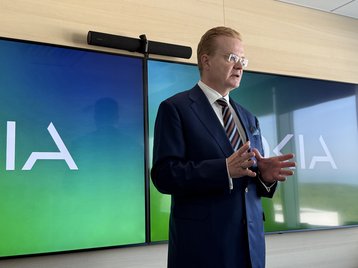
Speaking during a wide-ranging press briefing at the opening of the vendor’s research facility in Oulu, Finland, Tommi Uitto highlighted that AI is already “everywhere” in Nokia’s radio access network (RAN) offerings, including capabilities supporting machine learning from inside base stations.
Uitto told attendees that at the network management layer, the vendor’s MantaRay Self-Organizing Networks (SON) offering was being picked up by customers from some of Nokia’s closest rivals.
“You use [MantaRay SON] for optimizing network performance from various angles. It can be the downlink speed, the uplink speed, latency, or energy efficiency … it’s even used by some die-hard Ericsson customers who have 100% Ericsson radios, but they use it to manage the Ericsson radios.”
Uitto revealed the vendor has been testing to see if its AI-enhanced optimization platform can be used to autonomously configure networks without human intervention – a concept that would fall under Level 4 of the TM Forum’s certification program for advanced network automation capabilities.
Its MantaRay AutoPilot offering, for example, was deployed during the annual Hajj pilgrimage in Makkah, Saudi Arabia, earlier this summer, where it made around five million configuration changes across the three-day event.
Beyond automation and optimization, Uitto outlined that AI has the potential to augment higher up the stack for use cases such as service management and orchestration, and even intent-based networking, where an operator provides a desired business outcome, and the system takes the demand and applies it across the network.
AI to bolster network traffic
Nokia's interest in AI extends beyond network automation, driven by the anticipated surge in global network traffic. A Cisco executive recently indicated to SDxCentral that the deployment of AI agents could soon escalate network bandwidth to levels comparable to "80 billion" users.
Uitto cited Bell Labs' estimates that in the “modest scenario”, mobile network traffic will grow at least 19%, with the potential to reach as high as 5x over the next five to six years, with AI pushing traffic growth even further.
“[AI] will actually change the traffic profile, so that the uplink performance from device to the network, that traffic will grow, relatively speaking, more than the downlink,” he said. “This then drives network investments, and that's how we then indirectly benefit also in the radio access networks from the use of AI.”
‘Open RAN is not dead’
Beyond AI, Uitto was firm in his view of open architectures, telling the gathered press that Open RAN was “not dead.”
“We are fully committed to Open RAN. We are fully committed to cloud RAN. I know that there's been some hesitation in recent years about whether Nokia is really serious about Open and cloud RAN. We need to do a better job in expressing our full commitment to this.”
Nokia’s mobile network president suggested that Open RAN is already opening up monetization for carriers and customers for things like service management and orchestration, including slicing.
“We have seen that some of our operator customers have had success in monetizing slices where some parties are willing to pay more if they get certain guaranteed performance, as opposed to a first-come, first-served type of thing,” he said.
According to Uitto, even AI has the potential to apply its promises of improvement to Open and cloud RAN (c-RAN), which he likened to “interesting opportunities, which we still have to validate.”
“If you, for instance, build cloud RAN in such a way that some of the computing for base stations would be made with the AI-capable GPUs of companies like Nvidia or AMD, then maybe some of that computing capacity could be sold to anybody who needs inferencing capacity,” Uitto said. “In our wildest dreams, we could imagine the base station site being a far edge cloud site capable of cloud AI computing and inferencing.”
Tensions rising from the East
During an earlier part of the day, CEO Justin Hotard told a press briefing that Nokia risks being pushed out of the Chinese market. The company holds around 3% of the country’s market, with its CEO questioning why some European markets allow “high-risk” vendors to operate when “they do not allow us to play in their [Chinese] markets.”
Uitto also touched on the matter, saying Nokia was likely to be excluded from China for “national security reasons.”
There’s a suggestion that a total ban in China could have a cascading effect, forcing the hands of European lawmakers in a tit-for-tat removal of some of Nokia’s Chinese competitors.
“Many countries have already banned [certain Chinese firms], but there are also many countries that have not banned high-risk vendors yet,” he added.
Nokia does have a sizable defense portfolio, working with NATO to help transition member states towards 4G and 5G to complement their existing wireless systems. And this week, the vendor partnered with Motorola Solutions to develop tactical communications network solutions for defense agencies in the U.K.
Uitto said that alongside private wireless for enterprise, defense was among its fastest-growing market segments for radio access networks. Among industries that are snapping up its private wireless offerings are utility providers, oil and gas firms, and railway companies.





Comments