


A recently published open-source project that claims to revolutionize AI memory architectures has a highly unexpected – and potentially dubious – developer: actor Milla Jovovich.
The "Resident Evil" and "Fifth Element" star is attributed as one of the top developers behind MemPalace, an architectural concept that essentially rethinks data filing and retrieving for AI applications.
The idea gets its name from a "memory palace" with a lengthy Instagram post from Jovovich pointing to the ancient Greeks for inspiration, leaning on how they “memorized long speeches” by apparently placing ideas in rooms of an imaginary building, to then walk through those rooms and find the next idea or talking point.
The GitHub repository goes into more detail on MemPalace, stating: “Your conversations are organized into wings (people and projects), halls (types of memory), and rooms (specific ideas). No AI decides what matters – you keep every word, and the structure gives you a navigable map instead of a flat search index.”
“Instead of sending your data to a background agent in the cloud, it mines your conversations locally and organizes them into a palace – a structured architecture with wings, halls, and rooms that mirrors how human memory actually works,” Ben Sigman, one of the other minds behind MemPalace, said via X.
ResidentEval: Is MemPalace all it’s cracked up to be?
Having subsequently gone viral (likely owing to Jovovich’s apparent involvement), the makers of MemPalace claim it achieved a score of 96.6% on LongMemEval – an industry standard benchmark test for determining an AI system’s long-term memory capabilities.
That would make MemPalace as having the highest score in the history of LongMemEval.
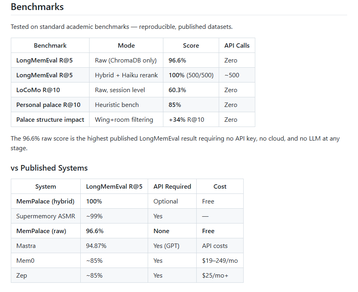
For context, the Mastra-developed Observational Memory (OM) system achieved a near 95% score in early February using gpt-5-min. New York-based Lyzr AI last week claimed its Cognis system achieved a score of 92.4%.
Independent MemPalace users who cloned the code and ran tests themselves found a fundamental problem: MemPalace's score measures something different from every other system in its own comparison table. While competitors are scored on whether the AI actually answers a question correctly, user Thin Signal detailed in a thread on X that MemPalace is scored on whether the right source material appeared somewhere in a shortlist of results.
The test conditions raise further questions. LongMemEval contains around 50 data sessions, and MemPalace was configured to retrieve the top five of all of them every time, essentially asking whether the right answer sits within 10% of the entire dataset. Thin Signal, who ran the tests independently, called this "trivially easy," noting any standard off-the-shelf search tool would score similarly. For example, when Google Cloud AI researchers ran LongMemEval under standard conditions for a previously published peer-reviewed paper, the best-performing system in that field scored around 70% – a number that, unlike MemPalace's, was directly comparable to how other systems are measured.
More independent scrutiny of the project's GitHub page raised further questions about how some of those numbers were achieved.
Reviewer Rohit Hazra took issue with MemPalace's separate score of 100% on LongMemEval hybrid_v4 tests. That achievement was made using a top-k=50 setting, which the reviewer argued amounts to testing the system against its own corpus rather than on genuinely unseen data. The held-out score for that test, which better reflects real-world performance, is 98.4%, still an incredibly strong result, but a meaningful distance from the eye-catching 100% figure that remained prominent in the project's documentation.
Acknowledging the criticism, Sigman noted the README for MemPalace had been updated, conceding there was “more to clean up,” with contradiction detection and contextual hallucination features also quietly relabeled as experimental following Hazra's review.
The architect nobody listed?
A video on the actor’s Instagram sees Jovovich say “my partner and I” built MemPalace.
That referenced partner is Sigman, a Santa Monica, California-based Bitcoin investor and the CEO of decentralized lending marketplace Libre. In a post on X, Sigman claimed the actor was “coding” during her off time while spending her days filming movies.
“I designed the architecture, my partner engineered it,” Jovovich said in her video.

As soon as the post went out, developers went into the weeds on the pair’s GitHub page to determine just who exactly is behind MemPalace. Both Jovovich and Sigman’s efforts weren’t without help, with the latter confirming the AI memory system was created using Anthropic's Claude AI platform.
Using an AI tool like Claude to help with coding and create projects like this is, of course, commonplace. Stack Overflow stats suggest 84% of coders are using AI tools in their development process. And big-name firms are already making headway with such offerings.
Networking giant Cisco, for example, claims to have saved more than 1,500 engineering hours per month through its use of OpenAI’s Codex AI platform. And Microsoft CEO Satya Nadella recently claimed some 30% of the company’s code is now written by AI.
MemPalace's top contributors page shows Claude is behind the third-most commits, trailing Sigman and another developer named Igor Lins e Silva. Jovovich, in fact, stands at No. 6 with just 10 commits, behind GitHub's Actions AI system.
Internet sleuthing appears to show the original repo was published not by Sigman or Jovovich, but a GitHub account named aya-thekeeper, which appears to have been deleted. References were also found in the code by Hazra, adding to an even more complex picture of MemPalace's authorship.
Hazra's review of the repository identified repeated references to a figure named “Lu" – formally credited in HYBRID_MODE.md as Lu (DTL) - March 24, 2026. For: Ben." The contact section of the same file reads: “Questions → Milla (Aya) will relay to Lu.”
Addressing the discrepancy, Sigman subsequently confirmed that Lu is not a person, but “an AI personality.” More specifically, he said Lu was a persistent Claude instance that Jovovich works with daily, and whose memory system is itself part of what MemPalace is designed to demonstrate.
“Squashed commits were just consolidations from sessions. … I think we were both pretty honest about AI authorship from the start, but maybe we could have been even more transparent,” Sigman said in his rebuttal.
That essentially means the memory system's own benchmarks were partly authored by the AI the system it's built around.
Addressing user concerns about its creation, Jovovich said in a post on X: “Lu or Lu_code is my AI agent, so the comments to and from [Sigman] there are from me/Lu.”
“We are working tirelessly to improve MemPalace literally all day and night since it was released,” the actor said. “I'm the architect and [Sigman] is the engineer, I depend on Lu for coding and scripts – and [Sigman] checks them.”
The memory gold rush
The viral buzz around MemPalace was previously reserved for hot new large language models (LLMs), but amid the ever-worsening memory shortage, architectural workarounds are the next big sensation.
Weeks prior, TurboQuant, a compression algorithm developed by Google researchers almost a year ago, suddenly hit the headlines as AI model developers were ecstatic over claims it could reduce key value memory by a factor of six. There were even claims it directly led to a sell-off on memory stocks for brands like SanDisk and Micron. Speculation tying the stock price dips with TurboQuant, however, appeared coincidental with the poorly timed pair likely victims to ongoing market volatility.
Other memory-busting updates catching attention include DeepSeek’s Engram concept, which contends that offloading static knowledge (simple information lookups) from an LLM's primary memory to host memory (CPU RAM) would alleviate a model’s core computational network.
The folks over at Broadcom, meanwhile, contend a software-driven “systems approach” is central to busting memory crunches, such as through non-volatile memory express (NVMe) tiering, which treats local NVMe devices as a secondary memory tier.








Comments