


Microsoft has teamed up with Ciena to create a blueprint to help operators shore up their optical infrastructure with zero-trust.
The nine-page blueprint details a survivability-by-design approach to ensure business continuity and disaster recovery in optical metro connectivity.
The pair contends that disruptions – stemming from anything from hardware faults to automation glitches – can impact even the most robust traditional transport infrastructure, such as ROADM (reconfigurable optical add-drop multiplexer) systems. ROADM features optical fiber networks capable of dynamically routing data signals without needing to convert them to electrical signals.
Microsoft and Ciena came together to outline a tiered optical architecture that essentially couples two completely independent segments: A ROADM-based network, along with an optical BCDR (Business Continuity and Disaster Recovery) layer. Connected via an edge router, the coupling eliminates the need for optical-level reconvergence or OTN switching.
To put it simply, the port channel handles the switch automatically, allowing data traffic to shift seamlessly between the two optical paths, which the pair argued simplifies operations and increases overall network resilience.
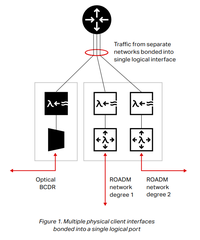
In the event of an outage, the jointly developed architecture allows operators to maintain full-capacity services with no manual intervention or traffic loss if one of those two optical systems is impacted by an event like a rollback issue or fiber assignments being misrouted at patch panels.
“Logical coupling at the client edge makes independent systems act as one, combining their strengths while avoiding single points of failure,” the white paper reads.
Microsoft and Ciena took the concept of zero trust, which is often applied to identity and security, and instead applied it to infrastructure isolation. The idea being, “[it’s] not a distrust of platform integrity, but a recognition that complex systems can be unintentionally taken offline through external factors.”
“By assuming such incidents can occur, and architecting for continuity, the network shifts from reactive recovery to proactive survivability,” the blueprint explained.
Microsoft, Ciena’s proposed ‘zero trust’ tiered optical transport design consists of:
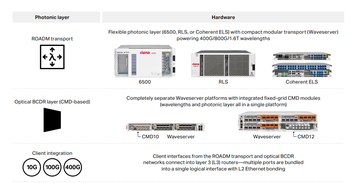
- A primary ROADM-based transport layer, built with Ciena’s 6500 or reconfigurable line system (RLS) photonic line.
- A completely independent, secondary optical BCDR transport layer, built using Ciena’s Waveserver demarcation devices, which extend networks closer to the edge, along with fixed-filter Channel Mux/Demux (CMD) modules.
- Layer 2 (L2) Ethernet bonding at the client interface, unifying both systems for seamless failover.
“Both optical systems are always live and active, each delivering production services through independent fibers, shelves, racks, power, and software stacks,” the blueprint reads.
“This tiered architecture doesn’t replace the inherent resiliency of ROADM systems; instead, it adds a layer of separation that keeps services running even during rare, high-impact events. It changes the mindset from responding to outages to prioritizing uninterrupted service.



Comments