

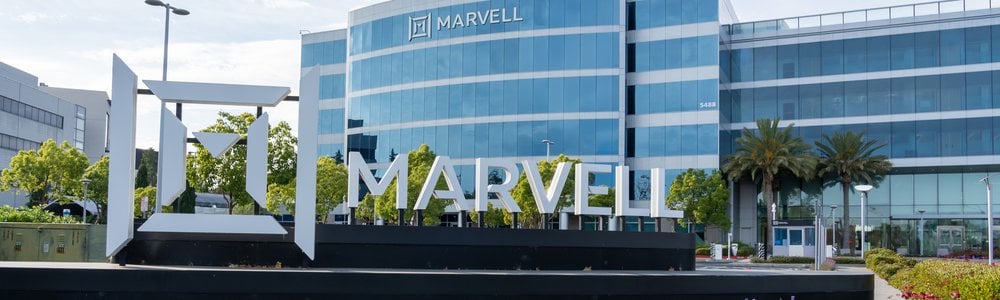
Marvell updated its three-nanometer (3-nm), 1.6 Tb/s (1.6T) optical digital signal processor (DSP) portfolio, joining a number of industry players looking to take advantage of surging AI-fueled data center connectivity demand.
Marvell’s Ara T DSP platform boasts support for 8x200 Gb/s (200G) transmit-retimed optics (RTO) that’s claimed to provide better power efficiency and a lower total cost of ownership. The new Ara X offering includes improved link reliability to support higher resilience in optical networks.
Marvell’s Petra is a 3-nm “gearbox” supporting 8x100G to 4x200G connections, providing better power efficiency and a more flexible infrastructure design, and its Aquila M platform gains integrated media access control security (MACsec) support for optical links.
The updated platforms are now sampling to customers.
The updates build on Marvell’s initial Nova launch in 2023, which was a 5-nm, 1.6T DSP supporting 200G per lane. This led to the Ara launch in late 2024, which was a 3-nm 1.6T platform.
Xi Wang, SVP and GM for Marvell’s Connectivity Business Unit, touted the updates as extending the vendor’s DSP and serializer/deserializer (SerDes) work within its legacy 800G platforms.
“With these new products, Marvell will deliver the performance, power efficiency, and manufacturing capacity required to keep up with the explosive growth of next-generation AI data centers,” Wang noted in a statement.
The updates also come quickly on the heels of Marvell expanding its coherent interconnect offerings, debuting a duo of 1.6T ZR/ZR+ pluggables and 2-nm DSPs, which the vendor linked to its support of scale-up, scale-out, and scale-across deployments.
They also join a chorus of AI-linked 1.6T optical equipment unveiled by vendors across the space. This includes recent products from Cisco, Ciena, and Naddod.
A recent report from Dell’Oro Group predicts 1.6T-capable network switches will “drive significant revenue growth,” with boxes supporting that capability expected to begin shipping during the second half of this year.

Comments