


Silicon photonics is set to dominate the optical interconnect market by the end of the decade, according to a report by China Insights Consultancy (CIC) for Chinese laser developer Yuanjie Semiconductors, which predicts a 23-times surge in silicon photonic-specific revenue between 2024 and 2030.
The report, commissioned as part of Yuanjie’s Hong Kong IPO prospectus, projects that global AI capex will total $4.7 trillion between 2026 and 2030. Among investments driving that surge is the need for high-speed optical interconnects, which are increasingly essential to support the scaling requirements of AI networks.
The CIC report, first spotted by Tom’s Hardware, suggests that demand will cause the global laser chip market to rise at a 44.1% compound annual growth rate (CAGR) from just $2.6 billion in 2024, to $22.9 billion in 2030.
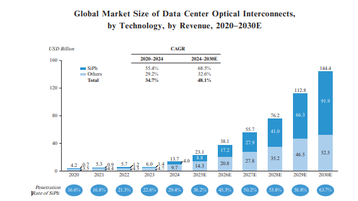
Silicon photonics underpin the laser chip forecast, which CIC projects will have a growth trajectory even steeper than the market it feeds. Silicon photonic optics revenues posted a 55.4% CAGR between 2020 and 2024, and will accelerate to 68.5% CAGR between 2024 and 2030. The consulting firm expects the technology to take up a 63.7% majority share of the market, up from being a minority niche just a few years ago.
The importance of silicon photonic optics to Yuanjie stems from the technology's use of its continuous-wave (CW) lasers paired with modulators in optics over electro-absorption modulated lasers (EMLs). Where EMLs involve complex fabrication processes, CW lasers are easier to produce and separating them from the modulation layer improves performance scaling in high-density environments, like in data center co-packaged optics (CPO). That means better power and thermal efficiency and a lower cost to produce.
CIC lists Yuanjie as the No. 2 company globally for supplying CW lasers for silicon photonic interconnects – making its emphasis on silicon photonic demand a strategic and potentially lucrative long-term focus for the company. Among its key customers is Huawei, which invested in Yuanjie in 2020.
The laser maker is already racing to meet increased demand, with plans for a new production facility near its headquarters in China's Shaanxi province.
The optics market as a whole is expected to heat up and could be warmed even more if President Donald Trump officials go ahead with rumored plans for a ban on imports of Chinese-made optical transceivers. Such a move could hamper Western AI infrastructure buildouts, with several Chinese firms among suppliers of optics to hyperscalers.
Integrated photonics were recently added as a technology of concern to the U.S. government’s National Security Science and Technology Strategy, which identifies critical national security technologies.






Comments