


The International Telecommunication Union's standardization unit (ITU-T) stamped a standardized low-latency photonic network framework developed by Japanese giants including KDDI, NTT, and NEC.
A total of seven Japanese firms are behind the framework, which aims to support low-latency and energy efficient connections between so-called all-photonic networks (APNs) run by different operators.
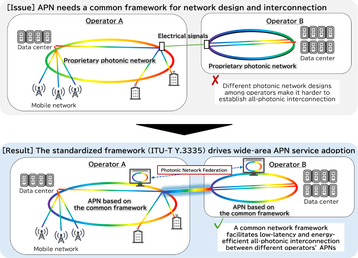
Their efforts have been championed by the NTT-led Innovative Optical and Wireless Network Global Forum (IOWN Global Forum), which has sought to develop common technical documents on APN architecture and functional requirements.
This latest win sees the ITU-T green light the framework as an international standard. But bringing the APN framework to life is far from over, with the Japanese giants working on a follow-up ITU-T Recommendation for the functional architecture piece, targeted for October 2028.
Japanese telecom operators and equipment manufacturers like Fujitsu’s 1Finity and Rakuten Mobile are among the players backing APN designs, which use light over traditional electrons to transmit and process data from end to end. NTT CEO Akira Shimada recently described the APN concept as essential for the company’s AI infrastructure pivot shortly before its DoCoMo carrier brand unveiled a testbed to showcase distributed graphics processing units (GPUs) connected via a wide-area network using low-latency optical links.
The ITU-T consensus won’t replace the Global Forum's technical work, but it does give the concept a shot at being adopted by operators outside Japan and the IOWN.
That goal received a sizable boost when IOWN expanded its partnership with the Linux Foundation's Cloud Native Computing Foundation (CNCF). The team up sees sees CNCF's work on composable hardware in disaggregated infrastructure (CoHDI) integrated into IOWN’s APN efforts.
The concept saw further validation back in July when Taiwanese operator Chunghwa Telecom partnered with Fujitsu's 1Finity networking arm to expand APN applications across the country.







Comments