

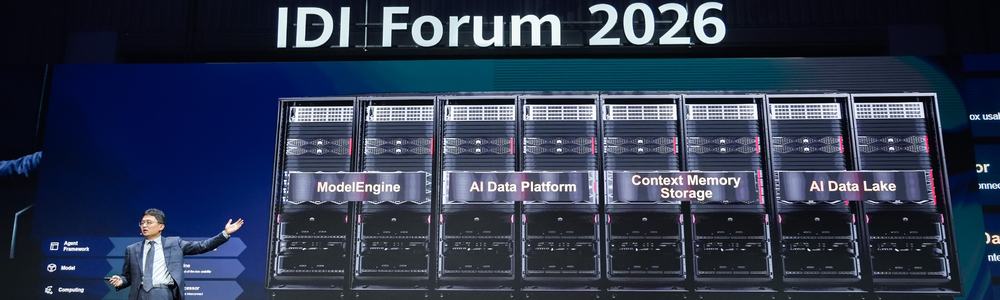
Huawei launched a full-stack data infrastructure offering for AI data centers.
Revealed during Huawei's Innovative Data Infrastructure (IDI) Forum 2026, the launch includes the OceanStor Pacific Scale-Out Storage offering, which provides 11 petabytes (PB) of storage capacity across a two-rack unit (2U) space. Huawei is also offering a context memory storage (CMS), which supports heterogeneous computing power and can expand into a petabyte-scale shared key-value (KV) cache pool that it claims reduces the time to first token by up to 90%.
"AI is unlocking new opportunities for the IT industry," Yuan Yuan, president of the Huawei Data Storage product line, told attendees at the IDI Forum. "The next chapter of AI is data. Committed to technological innovation in data storage, Huawei will accumulate the experience of industrial AI adoption, and work closely with the entire industry to help customers accelerate their journey into the intelligent era."
Huawei also announced its ModelEngine, which enables zero-code adaptation to new models and fast model deployment, along with compute resource partitioning and intelligence scheduling.
While Huawei uses the same technology in its Huawei Cloud, Yuan was keen to emphasize the importance of purchasing hardware to build AI infrastructure yourself.
"If you are really serious about bringing AI to your enterprise, you need to think about building the AI stack on-premises, to keep your privacy, complication modulation, and to generate the unique value by yourself," Yuan said. "You don't have to just use public AI services; you need a private stack."
Yuan later told SDxCentral sister site DCD: "As the hardware manufacturer, we hold a very optimistic view of the on-premises construction. Of course, many customers need to adopt cloud services to consume AI for training services, governance services and leverage using public cloud services, but there are still many customers because of their regulation requirements, privacy that, for them, it's not easy to put data on the public cloud. They need to build some on-premises infrastructure systems and to create their unique value," for example, health care, governments, and manufacturers.
"Gradually, I think many bigger enterprise customers will adopt on-premises construction models even at an early stage," Yuan added.
Yuan also noted that Huawei benefits from the current memory chip shortage.
"Yes, there are global issues with the upward trend of memory and storage media, but from my point of view, this is good," Yuan said. "We are storage vendors and storage can turn into a lot of value for us."
Yuan added noted that Huawei follows a multiple vendor strategy and can choose different vendors globally to serve for different assets. "We have global collaboration with major providers, so we don't have any supply chain problems," Yuan said.
Yuan noted that Huawei expects the memory chip shortage to continue until at least 2028.
Huawei this week also revealed its Grid Interactive AI data center (AIDC) strategy, which aims to deliver grid-friendly AIDC solution that maximizes tokens per watt.





Comments