


BARCELONA – When in Rome, do as the Romans do, as they say. As such, Hewlett Packard Enterprise (HPE) CEO Antonio Neri is in Europe talking about digital sovereignty like everyone else on the continent – perhaps more than HPE has ever done before.
Among the various announcements from its flagship European event Discover Barcelona 2025 was an update to HPE Private Cloud, which included the integration of Nvidia AI Enterprise in the cloud platform’s air-gapped environments, to meet benchmarks in Security Technical Implementation Guide (STIG) and Federal Information Processing Standards (FIPS).
HPE watchers may not be aware that this is a growing business opportunity for the vendor on the continent, enough so that there were enough of its customers available to speak at a media-facing session on sovereignty during Discover.
According to comments made by Neri at an intimate Q&A session after his Discover keynote, the sovereignty question isn’t alien to HPE, noting the firm already has trust in the public sector, something confirmed later to SDxCentral by a firm working with federal services in one EU nation.
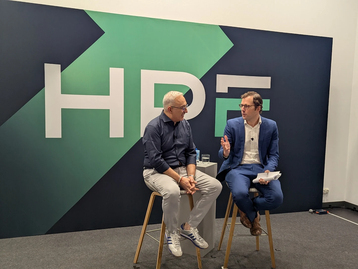
Public sector businesses “need more help than the traditional service providers” when it comes to supercomputing requirements, the CEO said, to confirm maintenance, security, and privacy requirements. HPE provided that help, and in turn is helping again as AI heats up the cloud data problem.
“There are a number of opportunities we're discussing today to build sovereign AI clouds and then ultimately do it in a very open approach, because they don't want to be locked in either. We built pretty much all the supercomputers in Europe, and which are now intersecting with AI.”
For Andreas Kranabitl, managing director, SPAR ICS, the HPE proposition is simple: Neri and company are attractive from financial, security, and multi-environment perspectives.
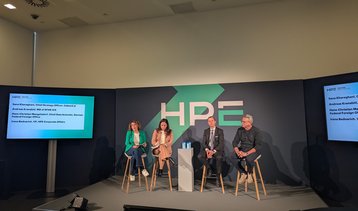
“The strategy of HPE to really cover most of the environment, having network, compute, and different clouds, all this solid architecture and solid programming, and solid strategy in AI makes me feel safe that they are doing the right things,” Krabanati said during a later panel.
This backs up Neri’s assertion that post-Juniper, HPE is an ideal solution for companies wanting scale up and scale across networking with their sovereign setups.
This also included capacity for sovereign clouds such as the SAP/Microsoft-headed Delos Cloud or the Google Cloud-powered T-Systems Sovereign Cloud, both of which are tailor-made for Germany, and which complement HPE infrastructure instead of being superfluous.
According to panel member Hans-Christian Mangelsdorf, chief data scientist of Germany's Federal Foreign Office, the currently formative Delos Cloud is being examined as an option, with SDxCentral understanding from a separate stakeholder that the T-Systems option is also being looked at.
Like any other cloud service, these clouds if deployed would work alongside HPE provisions in an enterprise stack for different use cases.
Neri also welcomed the challenge posed by neocloud providers that dovetail or have the potential to dovetail into sovereignty.
“In the end, it depends what business model they are pursuing,” he commented. “Some of them are offering GPU per hour basis. Some of them are actually building infrastructure and building tenants to it, because they don't have all the needs from a funding perspective … But if you look at all the announcements made … you’re talking about over over a 100 gigawatts and each takes 10s of billions of dollars to build, and when up and running, $7-8 billion to run. I think the new clouds will become specialized over time, more verticalized and just general purpose, whether it's serving the automotive industry, healthcare, and so forth.”
More in The Cloud & Storage Channel
-

-

-

Episode Is data AI’s biggest bottleneck?




Comments