

For years, AMD has always been the bridesmaid, never the bride. The perpetual runner-up is constantly measured against its big green rival. Its Advancing AI event last week, however, marked a stark difference for the perennial understudy, with high-profile partnerships and major product debuts showcasing a renewed capacity to close the gap and aggressively grapple with Nvidia.
Here’s what SDxCentral gleaned from the show floor:
Network double down sees mammoth densities …
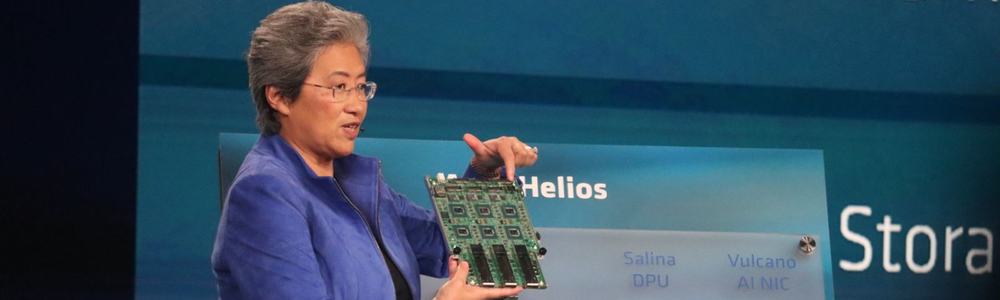
Helios was the big ticket item at the event in San Francisco. While it debuted at last year’s event, the 2026 iteration saw AMD actually reveal what’s under the hood.
For the networking-inclined, Helios is a powerhouse, at least if you go by the stats provided. Up to 260 Tb/s of scale-up networking per pod, pooling 72 MI455X graphics processing units (GPUs) across a single-tier one-hop Ethernet fabric – to borrow AMD Pensando VP Krishna Doddapaneni’s words, that’s a “humungous” amount of bandwidth.
For scale-out, Helios leans on the second-generation Pensando AI network interface card (NIC), dubbed “Vulcano,” to offer 43 Tb/s. The vendor claimed that’s 50% more bandwidth than Nvidia’s Vera Rubin NVL72.

These stats are, of course, from the vendor themselves and do warrant some level of scrutiny, and we’ll get actual deployment verifications once these racks are online. But to AMD’s delight, a whole host of names will be doing that for them. We already knew Hewlett Packard Enterprise (HPE) and Microsoft had signed on to deploy the NVL72 rival, and Advancing AI saw Cerebras, OpenAI, and Meta sign on in a show of force.
Speaking with SDxCentral on the sidelines of the event, AMD Senior Fellow David Riddoch said the development of the networking stack for Helios encompassed a “multi-year process” encompassing “enormous” amounts of analysis, trade-offs, and changes of direction.
The network powering Helios is underpinned by technology developed by Pensando, which AMD spent $1.9 billion on the brand back in 2022. The development of Vulcano and the Salina data processing unit (DPU) managing the front-end mark a shrewd bit of planning and patience on the part of AMD. Only time will tell if those performance numbers hold up.
For more, read: AMD challenges Nvidia’s networking dominance with Helios racks boasting 50% higher bandwidth
… and optics on the horizon?
For all Helios’ apparent networking prowess, there was a slight elephant in the room – not in reference to Nvidia’s Spectrum 6, which cheekily dropped the day before the event kicked off.
Optical connectivity is the next big thing. Nvidia has been banging on about it since 2024 when it unveiled to the world plans for co-packaged optics (CPO) versions of its Spectrum-X and Quantum-X fabrics.
For AMD’s part, though, the view on optics has been considerably more schtum, to say the least. The only concrete confirmation we got was that the next generation of its flagship Instinct GPU platform, 2027’s MI500 series, would cater to both copper and optical connectivity, which CEO Lisa Su confirmed at the tail end of her keynote.
And yet, when it comes to optical connectivity in Helios? Silence – it’s an all-copper system, at least for now.
There is the whole "don’t put the cart before the horse" argument, and AMD is nothing if not more reserved than its brasher, greener counterpart. But while Nvidia is gearing up to launch optic editions of its flagship switch line later this year, things look a little further afield for AMD.
SDxCentral sought some answers in the technical networking briefing, but was rebuffed, with Doddapaneni describing it as “a future thing.” The Pensando VP did say the team “has been talking about it,” but declined to comment on future roadmap plans.
That doesn’t mean optics aren’t going to be a part of AMD’s plans for boosting connectivity, but Advancing AI felt lackluster on this part. Maybe for the best, with Nvidia having to bring in materials engineers to help solve heat issues with its upcoming ConnectX-9 lines stemming from reported power consumption issues.
For more, read: AMD to join the optical interconnect party with 2027 Instinct GPUs
AMD v Nvidia is now Groq v Cerebras
One of the more surprising headlines from the event was that AMD had convinced Cerebras to become a Helios partner.
The maker of some of the largest semiconductors in the world is on board with a technical partnership that will see its Wafer-Scale Engine integrated as part of Helios. The pair came together claiming the converged rack-scale offering would provide up to five-times higher tokens per second per watt (T/s/W). Given Cerebras’ already impressive ultra-low-latency performance capabilities, means that’s a lot of tokens.
And while it’s hard to avoid the Nvidia versus AMD narrative, this deal adds a whole new dimension, pitting the new partner up against Groq, the firm acquired by the former at the tail end of last year.
March’s GTC event already sparked that debate, with Cerebras practically celebrating the launch of Nvidia’s Groq 3 language processing unit (LPU) as a justification for its bet on static random-access memory (SRAM) to power low-latency computing. With its chips set to be placed inside a rack-scale system with AMD’s backing, it’s a potentially frightening partnership to face and could well turn the heads of a lot of token-hungry hyperscalers wanting ever-faster workloads.
For more: AMD, Cerebras partner on joint Helios rack-scale AI inference platform
Developers, developers, developers: ROCm showcase pushes past InferenceMAX debacle
March’s InferenceMAX benchmark results from SemiAnalysis painted AMD in a poor light compared to Nvidia in terms of software stacks, going as far as using "Gen Alpha" slang to claim ROCm “gets absolutely mogged” by CUDA.
AMD took the somewhat childish framing to heart, it seems, as it threw its weight behind its software stack at Advancing AI. In a show of passion for developers not seen since Microsoft CEO Steve Ballmer’s infamous sweat-induced chant, AMD put out all the stops.
While much cleaner cut than Ballmer, AMD SVP of AI Vamsi Boppana brought to the keynote stage some of that same passion, confirming the firm had increased investments “at every level” in staffing across build and test infrastructures and that ROCm releases would go from every four months to every six weeks, providing “more features, faster performance, and a significantly better out-of-the-box experience.”
A strong start, but the real high-ticket software item was the reveal of ROCm.ai, a so-called “AI-native developer experience” that in Boppana’s words “brings the capabilities of AI-assisted GPU programming to developers.”
Spanning three layers, including a CLI centric offering that installs, validates, serves, and recovers AI workloads culminating in an air-gapped interface for environments without a cloud connection. The offering also includes "skills," which places knowledge directly into popular AI coding assistants like Cursor, Codex, and Claude, providing AMD-specific recipes for everything from migrations to debugging.
“For years, we have been building the open software foundation. Now we are adding an AI-assisted layer that helps developers use that foundation faster and more effectively,” Boppana said during the keynote.
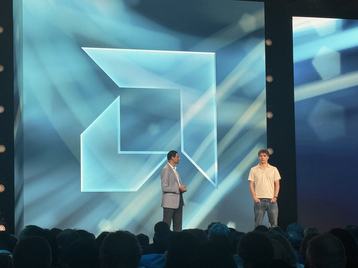
If that message of democratization combined with increased feature rollout more generally doesn’t resonate with developers, then maybe some words of praise from Philippe Tillet, the lead mind behind Triton, the de facto open-source high-level abstraction tool from OpenAI.
“The entire compiler stack from AMD is open source and that has allowed us to make our agents really good at very, very low level regeneration, down to scheduling instructions in assembly, and this has led to like very very significant performance gain that I don't think we have would have been able to to achieve in a fully closed source stack,” Tillet said on stage.
For more, check out: AMD strikes back: The two-front battle with Nvidia for AI software & CPU control
Nvidia pulls ahead as AMD's software stack falls short: report
Advancing AI is growing, still room for improvement
Again, it’s hard to talk about one vendor without the other. Nvidia’s GTC event has morphed into a quasi-festival of sorts. The abhorrent usage of the moniker "the Super Bowl of AI," for example, is bandied around every spring.
For AMD, a dedicated major showcase wasn’t really a thing, instead saving flagship reveals for Computex or, God forbid, CES.
The 2024 edition of Advancing AI was small, with the show floor area encompassing just a handful of players. Last week’s event was much bigger, with references to some 10,000 attendee numbers floated around in conversations on the show floor. Vendors that spoke with SDxCentral were, for the most part, pretty happy, describing a real hodgepodge of folks from buyers to kids fresh out of college wanting to get started in AI.
Now, while AMD has done some monumental work building out its offerings to compete, when it comes to events, catching up to GTC overnight simply won’t happen.
If AMD wants to make open source its "moat" for lack of a better word, then Advancing AI should really play into that in the long term. That means tapping into that festival feel, taking advantage of the rich tech ecosystem of San Francisco and bringing folks together. In two years alone, it’s done some of that work, but it’s a long way to go to catch the feeling of a GTC.
The firm should learn from what it’s done with ROCm: evolve from defensive posturing to be aggressive. No Dreamforce levels of bravado by any means, but lean into creating an open-source festival of sorts. Less leather jackets, more community-focused, on-site activities, maybe even"vibe-coding" hackathons.




Comments