

Google has described how it is evolving its networking infrastructure to support AI workloads, bringing together a series of recent technologies into a unified architecture spanning accelerator fabrics, data center networks, and global backbone connectivity.
In a blog post, the company argued that AI is reshaping requirements across every layer of the network stack as increasingly large models demand more bandwidth, lower latency, and the ability to distribute workloads across multiple facilities.
While the announcement focuses primarily on previously disclosed technologies rather than a major new product launch, it provides a clearer picture of how Google's recent networking investments fit into its wider AI Hypercomputer strategy.
The company recently unveiled Virgo, a scale-out networking fabric designed to connect accelerator racks and support clusters containing up to 134,000 chips. Virgo uses a flatter two-layer topology intended to reduce latency and increase bandwidth for large-scale AI workloads, offering up to four times more bandwidth per accelerator and 40% lower unloaded fabric latency than previous approaches.
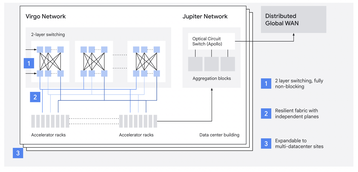
Google positions Virgo as one layer in a broader networking architecture. The company argues that AI infrastructure increasingly requires coordination across data centers, campuses, and geographic regions rather than within individual facilities.
That architecture also incorporates Google's Jupiter data center fabric and global wide-area network (WAN) backbone. Together, these technologies are intended to allow AI workloads to access distributed compute and storage resources while maintaining the performance characteristics required for large-scale training and inference.
The company said power availability is becoming an increasingly important constraint on AI deployments, forcing infrastructure operators to distribute accelerator clusters across multiple buildings and campuses. As a result, networking is becoming a critical component of AI infrastructure design rather than simply a mechanism for connecting servers.
Google described this approach as treating an entire campus as a single computer, with optical networking and interconnect technologies enabling workloads to operate across multiple facilities as though they were part of a unified system.
The announcement also builds on recent enhancements to Google AI Hypercomputer, including support for Nvidia's Collective Communications Library (NCCL) and technologies designed to improve communication between distributed GPU resources.
Rather than focusing on a single networking product, the announcement provides a roadmap for how Google expects networking to evolve alongside AI infrastructure. The company is effectively positioning accelerator fabrics, data center networks, and backbone connectivity as components of a unified AI platform designed to scale beyond the limits of individual facilities.



Comments