


Google Cloud revealed Virgo, the new networking fabric orchestrating workloads for its AI Hypercomputer platform.
Showcased during the hyperscaler’s annual Next event, Virgo is a scale-out fabric designed to connect accelerator racks. Capable of interconnecting 134,000 chips, Virgo can support upwards of 47 petabits per sector of non-blocking bi-sectional bandwidth in a single east-west fabric.
The fabric leverages high-radix switches – meaning they house a sizable number of ports – to essentially reduce the number of network layers. More ports per switch means Google platforms leveraging Virgo feature a flatter, two-layer non-blocking topology. Compared to traditional three-layer data center networks, Virgo’s two-layer design offers reduced latency.
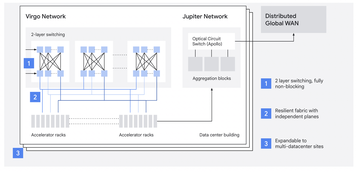
In a blog post, Google engineers claim Virgo offers a “generational performance leap,” providing up to four-times the bandwidth per accelerator and as much as 40% lower unloaded fabric latency.
“Virgo Network is a reimagined scale-out data center network custom-built for the stringent demands of modern AI workloads,” the hyperscaler’s post reads. “This flat, multiplanar architecture unifies accelerators across pods into a single compute domain, addressing the bandwidth and scale limitations of traditional networks.”
Google’s reveal of Virgo comes as the hyperscaler is building out its custom infrastructure stack. The networking fabric coincided with the launch of the inference-optimized version of its flagship Tensor Processing Unit (TPU) custom silicon.
Virgo, in fact, is specifically designed with the new TPU 8t in mind, bolstering the hardware’s SparseCore dataflow processors, which offload data-dependent all-gather operations (where data is pulled from across the system only as specific calculations require it) in a bid to prevent bottlenecks.
Beyond improved utilization, the scale-out fabric is also designed with fault isolation in mind to ensure a system supporting hundreds-of-thousands of chips isn’t interrupted when inevitable hardware failures occur. It features integrated independent switching planes that provide fault isolation, ensuring system-wide "Goodput" isn’t impacted by localized hardware failures.
Software and orchestration tools also allow Google engineers the ability to monitor nodes experiencing performance degradation – meaning they can accelerate workloads and proactively prevent slowdowns.
Arguably the most important addition is the ability for accelerator racks connected via Virgo to interconnect with Google Cloud's flagship Jupiter north-south fabric, creating streamlined access across compute and storage systems.


Comments