


Fortinet, Palo Alto Networks, and Check Point were crowned “leaders” in Gartner's latest Magic Quadrant for hybrid mesh firewalls (HMF), with some big-name vendors left to languish further down the rankings.
The analyst firm’s latest Magic Quadrant examines HMFs, which offer unified cloud-based support for multicloud and hybrid environment firewall use cases, as well as data center, enterprise perimeter, and office use cases.
The top leadership position went to Fortinet, with the Sunnyvale, California-based vendor praised for its market understanding and speed in introducing products to protect users from emerging threats, such as its post-quantum cryptography (PQC) offerings.
The security vendor has a storied history when it comes to achieving leadership status in Gartner’s network firewall reports, while only breaking into the increasingly crowded leader box for the analyst firm’s secure access service edge (SASE) provider rankings in July.
Its FortiFlex offering, which helps implement flexible HMFs that customers can tune in line with their deployments, also caught Gatner analysts' attention.
However, vulnerabilities with its products were identified as a point of concern for customers, despite the firm making attempts to phase out potentially impacted offerings.
The analyst firm also identified some frustration from surveyed customers, with a lack of visibility into Fortinet’s HMF roadmap “making it difficult to evaluate short- and medium-term product vision” versus the competition.
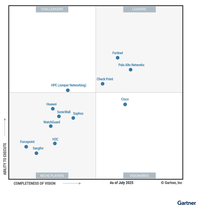
Closely following Fortinet as a leader was Palo Alto Networks, whose HMF offerings are delivered through its centralized cloud-based manager, Strata Cloud Manager, which enables customers to orchestrate various firewall deployment types alongside the cloud manager product.
The Santa Clara-based vendor was lauded for having infused AI into its HMF security offerings, which help to continuously assess the severity of threats by learning from previous risk and policy enforcement decisions.
Described by Gartner as “the most visible vendor for HMF use cases,” Fortinet was lauded as “a desirable choice for HMF clients seeking unified cloud management along with SASE and security service edge (SSE)” through its Strata Cloud Manager.
Clients did express concern over the vendor’s higher renewal costs, which Gartner suggests forces customers to sign short-term contracts rather than multiyear deals.
“The total cost of ownership of Palo Alto Networks HMF is relatively higher than direct competition and is one of the key reasons clients tend to migrate away,” the analyst firm found.
Gartner also found that some clients expressed having to run both Strata Cloud Manager and Palo Alto Networks’ Panorama firewall management platform “for at least a year before they can fully move to Strata Cloud Manager”, while others experienced performance-related issues, like slow boot times and high resource requirements, for its hardware firewalls.
Rounding out the leader positions was Israeli vendor Check Point, which offers hardware, virtual, managed firewall-as-a-service, and cloud-native deployment options.
The Tel Aviv-based vendor drew praise for its pricing, with Gartner noting it was the only vendor on its list to offer a publicly available pricing portal for all its hybrid mesh firewall products, along with flexible subscription-based licensing models for hardware appliances.
Check Point lost out, however, after surveyed clients revealed to Gartner complexities around initial setup and operational complexity when using its tools.
The vendor was also marked down for its lack of containerized firewall offerings, with no remote browser isolation and advanced SD-WAN capabilities compared to its market competitors.
HPE stands as lone challenger following Juniper deal
Gartner's latest Magic Quadrant for Hybrid Mesh Firewalls contained just one “challenger” – Hewlett Packard Enterprise (HPE), courtesy of its recent acquisition of Juniper Networks.
The newly combined vendor offers hybrid mesh firewall capabilities via its Security Director Cloud platform, as well as a range of deployment options and licensing models, and subscriptions to support various deployments or specific products and services.
Despite its name and presence, HPE/Juniper found itself in the challenger spot due to constrained past investments and “uncertainty of future investments” following the high-profile acquisition.
Gartner found a lack of dedicated security branding, with overall marketing more geared toward integrated infrastructure and newly converged HPE Juniper Networking products, which the analyst firm suggests makes it "more desirable for network and infrastructure teams than security teams.”
A lack of a SASE offering under the analyst firm’s definition also made HPE “less appealing to HMF customers who desire a centralized cloud-based manager” for managing both HMF and SASE.
Another big name that found itself outside the leadership quadrant was Cisco, with Gartner placing it in the “visionary” category.
Cisco’s HMF offerings are marketed through its centralized cloud-based manager, Cisco Security Cloud Control (SCC), while it also offers HMF licensing through its Cloud Protection Suite.
The vendor’s multiple flexible firewall deployment types were a notable tick in its favor, enabling its customers to support hybrid environments, unlike some of its direct competitors. Additionally, its extensive geographical presence meant it could provide technical support in the widest array of regional languages.
Cisco found itself in the visionary category rather than leadership because it was “rarely seen in stand-alone HMF and cloud firewall shortlists,” Gartner found, despite the firm boasting mature offerings.
“The vendor displays one of the lowest new customer acquisition volumes in this market,” the analyst firm added, with Cisco's focus on infrastructure as a fabric creating what Gartner labeled as a “disconnect with the chief information security officer teams as the primary buyers and negatively impacts the network security brand.”
Huawei, SonicWall lead crowded niche player pack
The most populous quadrant was the “niche players” segment, with some seven vendors, including Huawei, SonicWall, and WatchGuard, finding themselves in this category.
Vendors are placed into the niche player category if Gartner’s analyst finds they focus on specific portions of the market, be it use case, geography, or vertical.
Huawei was among the top-ranked in this category, with the firm losing out as its support was found to be limited to Huawei Cloud only. “The vendor lacks a mature SASE offering, limiting its appeal for those looking to extend HFM to SASE through a centralized cloud management,” Gartner’s report states.
British-based Sophos was another leading niche player in Gartner’s Magic Quadrant, with the vendor losing out due to a lack of dedicated HMF-based positioning, with a primary focus on cloud firewall use cases.
The analyst firm also found some overlapping capabilities between Sophos’ Firewall and Endpoint products, which can “leave clients uncertain about which product best fits their needs and can be a factor in clients considering alternative vendors with more streamlined portfolios.”
Rounding out the leading niche players segment was SonicWall, which offers HMF capabilities through its cloud-native SonicPlatform.
The Milpitas, California-based firm was lauded for its cost-effective pricing models that Gartner described as “highly desirable for managed security service providers (MSSPs) and small to medium-sized businesses (SMBs).”
However, its focus on MSP customers means SonicWall does not have direct end-user branding, which Gartner said meant end users had “limited awareness” of its HMF offerings.



Comments