


Everpure, Huawei, and Hewlett Packard Enterprise (HPE) navigated supply chain volatility and intense industry replatforming to come out on top in Gartner’s latest Magic Quadrant for enterprise storage platforms.
The analyst giant projects that a “meaningful percentage” of enterprise workloads will migrate from VMware to other platforms by 2028, opening the door for IT leaders to reevaluate the combination of their virtualization and storage platform needs. Combing that with the intense memory supply imbalance resulting in soaring costs makes this a particularly poignant Magic Quadrant.
It was the kings of flash, formerly known as Pure Storage, that ranked the highest then, with Everpure praised for its cost competitiveness and ability to ride the supply chain storm.
Gartner highlighted continued investments by the vendor in its Enterprise Data Cloud vision, which sees it replace rigid storage silos with a horizontal, shared pool of configurable resources in what Everpure described as a “data primacy” play.
Analysts also lauded Everpure shielding end users from supply chain volatility through “nondisruptive service-level assurance (SLA)-backed outcomes.” While the vendor, like many on the list, raised costs substantially in 2026 – by some 70% between January and April – CEO Charlie Giancarlo said it’s been moving to help customers by taking some of the heat in order to help customers.
Despite cost-easing claims, Gartner’s cautions for the orange-clad Everpure were that more cost-conscious players may see it as a high-cost option, noting “particularly for capacity-centric use cases where competitors offer lower-cost hard disk drive (HDD) media and more economical support contracts.”
The vendor also lost points for lacking presence in some emerging countries as well as support for a cross-platform global file namespace, which forces users to adopt the vendor’s specialized, high-end appliance.
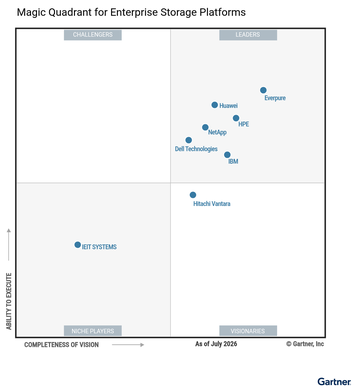
Following Everpure’s lead were HPE and Huawei.
HPE earned commendation for its Alletra Storage multiprotocol (MP) architecture, with Gartner praising it for allowing users to scale performance and capacity across block, file, and object workloads across all HPE Data Services, including Morpheus VM Essentials, and Private Cloud AI.
HPE lost points from the perception from buyers adopting its storage solutions require a full transition to its GreenLake ecosystem, leading to firms overlooking the vendor's standalone hardware offerings during prospective procurements. The vendor’s struggle to gain hybrid cloud traction was also cited, with analysts suggesting customer usage was largely confined to data protection.
Huawei drew plaudits for its deep vertical integration and proactive integrations of cryptographic controls that help customers reduce data center space, power requirements, safeguarding data from emerging threats. Its Unified AI Data platform was also highlighted for helping simplify enterprise AI deployments.
A lack of support automation and presence in Western hyperscalers was where Huawei lost out, with the latter point of particular note given export controls hampering its ability to operate in some markets.
Expanding the 'leadership' square: NetApp, Dell, and IBM
Rounding out what was a packed "leaders" quadrant were NetApp, Dell Technologies, and IBM.
NetApp placed the highest of the three with Gartner lauding its storage operating system native embedding within major hyperscalers including Amazon Web Services (AWS), Microsoft Azure, and Google Cloud. And amid an industry gripped by supply chain fears, the company’s decision to manufacture in Mexico and diversify its component supply chain away from China was noted as a positive.
The vendor’s “premium” pricing model, high capital expense, and “expensive ongoing maintenance contracts” were among the criticisms leveled against it by Gartner analysts. Cautions listed for NetApp also include a “confusing” graphical user interface that it said required administrators to “face a steep learning curve, often relying on command-line interface inputs to fine-tune the system.”
Dell was praised for continued investments in its PowerStore line and expanding AI Data Platform, the latter of which is purpose-built for Nvidia deployments, earning it plaudits from more AI infrastructure-conscious customers. Away from AI though, Gartner also highlighted the vendor’s comprehensive portfolio as a whole, catering for any workload.
But making use of separate purpose-built platforms for structured and unstructured workloads combined with architectural innovation gaps saw it lose out compared to others.
The last in the coveted top-right quadrant was IBM, with its agentic integrations directly into its platform a positive inclusion by analysts. Gartner noted that agent-based additions allow administrators to orchestrate complex operations and provision workloads far more efficiently using natural language.
But a lack of a native unified platform and a “burdensome” architecture for smaller players saw Gartner dock points for the storied player.
Beyond the top-right
Gartner's "visionary" and "niche players" quadrants each housed just a single vendor.
Hitachi Vantara was on its lonesome in the former category, with Gartner citing it as having relatively lower market visibility.
The analyst firm said the vendor has struggled to gain wide adoption in AI training and inferencing environments compared to its peers “because it lags market leaders in the breadth and depth of its dedicated AI data services.” Higher upfront costs from its midtier storage arrays were highlighted as being “frequently cited by customers” as expensive compared to comparable lines.
Hitachi Vantara did, however, draw praise for its contractual 100% data availability guarantee for its flagship Virtual Storage Platform (VSP) One portfolio. While a unified cloud management approach for VSP 360 was also positively highlighted for providing AI-powered autonomous means to manage block, file, and object storage.
IEIT Systems was the only "niche" player, with the vendor cited as being heavily concentrated within its domestic Chinese market and select regions in Asia Pacific, which Gartner said could create possible support issues for globally distributed enterprise deployments. An “opaque” product roadmap and a more reactive, highly manual support model were also among the analyst firm’s cautions.
Strong supply chain capabilities and integrated delivery model saw it billed as a vendor capable of delivering highly cost-effective capacity scaling for large enterprise datasets “without premium markups.”
Is someone missing?
A notable absentee from Gartner's latest Magic Quadrant was DDN.
The vendor’s high-performance data storage and management offerings has seen it court some major clients, including xAI and the neocloud Lambda. But it found itself dropped from this list.
Gartner does not tend to specify why a vendor loses its place on one of its coveted Magic Quadrants, noting that an appearance one year and not the next “does not necessarily indicate that we have changed our opinion of that vendor. It may be a reflection of a change in the market and, therefore, changed evaluation criteria, or of a change of focus by that vendor.”
Despite being dropped, DDN marches on with reports earlier this year suggesting it’s eyeing further investment, having already secured $300 million from Blackstone back in January. That earlier injection came off the back of industry reports that the firm was mulling a potential IPO.



More in The Cloud & Storage Channel
-

-

-

Episode Is data AI’s biggest bottleneck?
Comments