

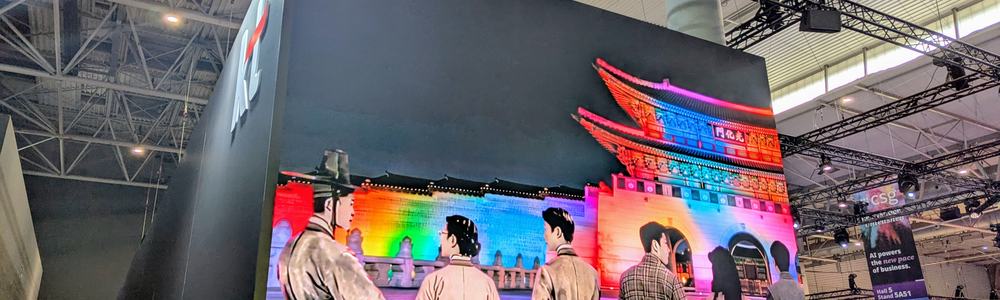
South Korea’s tech giants drove autonomous network efforts via a digital twin-infused 5G demo using AI modeling predictions.
In a joint demo, Samsung Electronics and telecom operator KT tackled the lag in network optimization that arises from manual adjustments of base station configurations, where impact can only be evaluated after implementation. Samsung and KT's approach leveraged AI models trained on commercial network data to analyze interactions between neighboring base stations and generate candidate configurations. A digital twin was used to simulate their effects and predict network performance, with AI evaluating the results and selecting the optimal configuration.
The companies tested the system over three months at KT Wiz Park baseball stadium in the Seoul satellite city of Suwon, as chosen for its traffic-heavy nature via fan streaming and social media use. Throughout the trial, the AI system continuously monitored changes in user locations, mobility, and traffic patterns to generate suitable 5G base station operating configurations, which were then evaluated by the digital twin.
According to Samsung, the trial achieved a maximum 34% reduction in traffic-load variation between base stations and a maximum 16% reduction in traffic concentrated on individual base stations. Samsung also reported a high degree of agreement between the digital twin's predicted performance and the results observed on the commercial network.
In a translated announcement, Jin-kook Jeong, executive VP and head of next-generation communication research Center at Samsung Electronics, commented that "the two companies have developed technology that can be applied to actual commercial networks by pre-verifying optimization solutions derived from AI using digital twins. We will continue to lead network innovation with future communication technologies that improve both network operational efficiency and user experience."
Jong-sik Lee, executive VP and head of the Future Network Lab at KT’s Network Division, added: “Through this demonstration, we have confirmed the feasibility of applying AI cell twin-based autonomous operation technology to commercial networks. KT will continuously advance AI cell twin technology to proactively respond to the changing network environment and, through this, realize an autonomous network that provides better communication quality to customers.”
The effort broadens Samsung's footprint in the telecom twin space, with the Korean giant recently joining a consortium led by Japanese operator KDDI to develop a radio access network (RAN) digital twin aimed at supporting autonomous network operations in the 6G era. KDDI also leveraged Samsung equipment recently to trial an AI-RAN optimization platform on a live 5G standalone (SA) network.
Where the KT trial was cell-based, Samsung technology also helped power another Japanese effort this summer, when NTT DoCoMo validated AI-RAN optimization tech at the smartphone level.




Comments