


BARCELONA – Cisco Chief Product Officer (CPO) Jeetu Patel claimed telecom operators are becoming inference providers to enterprises, as the AI boom dominated talk at this year’s Mobile World Congress (MWC) event.
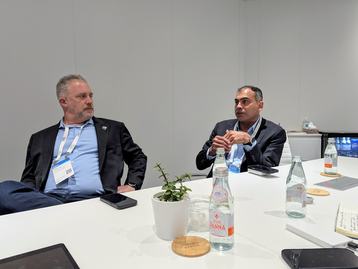
The insight came from an exclusive Cisco roundtable held at MWC, where execs positioned Cisco’s role in the telecom industry, while revealing a few nuggets on AI security and “space across” networking with extraterrestrial data centers.
Telcos to serve a tokenistic future
Looking back over the last twelve to eighteen months, Patel said Cisco is starting to see telecom operators getting “into the space of becoming inference providers to enterprises,” as AI agents begin to proliferate in the business realm.
“Telcos have entirely a different kind of opportunity for not just the kind of value they can bring, but the kind of monetization that they can provide for companies as a result of providing this global connectivity fabric," Patel said. "Because you're going to need to have these agents talking to humans in all different parts of the world, and you're going to need to have a very different kind of infrastructure than what we've had before to sustain them."
Perhaps unsurprisingly, Patel added Cisco as being “the critical infrastructure company for the AI era,” ready to provide optics, chips, systems, and security for scale across networking.

“Competitive differentiation in the future is going to be a country or a company's ability to have secure and efficient generation of tokens; everyone's going to be building out token generation factories," Patel said. "And as you build out these token generation factories, every country is going to want to make sure that they have a level of independence to make and control their own destiny and have their own token generation factories. And we want to provide the necessary infrastructure."
In a follow-up conversation at MWC 2026, Ken Seitz, global senior director for partner managed services at Cisco, said that following the vendor's recent 360 partnership reshuffle, telecom partners remain "strong co-design partners in the AI journey, taking advantage of AI innovations across their operations, assurance and GTM (go-to-market) motions."
That reshuffle, angled toward the AI era, did see some "universal negativity" as the program was in its infancy, according to ZK Research Principal Analyst Zeus Kerravala, who added that partner reactions now were "180 degrees" from where the 360 program was a year ago.
"It's been a long road getting here but the majority of partners are happy with the change, which I would not have said a year ago," Kerravala said.
Actual AI use in telecom
When asked how Cisco customers and partners are actually seizing the AI opportunity, Gurudatt Shenoy, SVP of the Cisco Provider Connectivity group, pointed to “pretty widespread adoption” of data center interconnects, as well as opportunities in the industrial space for providers.
“Just as an example, if there's an enterprise manufacturing facility that needs connectivity to local data centers or remote data centers, there are performance constraints. They may need network slices that are dedicated with certain latency, performance constraints, guarantees around it, security of the data, sovereignty of the data, potentially depending on the region," Shenoy explained. "All of that has to be provided by the service provider, and that's an opportunity for them to offer a differentiated connection other than rather than just sending it over the internet."
Shanoy cited the customer case of Colt Technology Services, which hosts a number of services built on top of Cisco’s segment routing infrastructure, providing differentiated connectivity services for AI applications.
“Also, when it comes to using AI and some of the agentic platforms that we've developed in Cisco, using that to manage networks and get efficiencies in operating networks with using AI, we're seeing good motion there when it comes to offering services and monetizing using AI, inferencing, etc.,” Shanoy added.
On the hot potato of agentic security, Patel reminded the room that Cisco has one of the world's largest security businesses, with a promise to double down on that area. This extends to AI security, with Cisco keen to set down agentic guardrails, as following its work with Cisco Outshift, which saw it develop the Agntcy agentic AI directory that it donated to the Linux Foundation last year.
“[But] this goes beyond Outshift,” Patel told SDxCentral. “We actually have products in production and market today."
Away from agents and pointing to collaborations with Nvidia in the AI radio access network (AI-RAN) space, Kevin Wollenweber, SVP and GM of data center and internet infrastructure at Cisco, said the vendor is looking at AI-RAN in more than one way.
“You hear a lot of this when people talk about AI for the RAN, which means how do you use AI technologies to make that RAN more efficient," Wollenweber said. "But there's also how we use the RAN for AI: so how do you actually use the fact that you have direct connectivity to customers, you're a lot closer to that customer base, and you now have accelerator resources in that RAN infrastructure? So the thought process is, we can start to deploy more AI based services towards those end customers, leveraging that equity.”
AI bubble ain't a thing
Regarding the hot topic of the AI bubble, Patel dismissed concerns that the AI dream will come crashing down for telecom and other verticals, asking that people should not confuse “frothy” and gargantuan valuations for certain AI vendors with the potential for an oncoming collapse in AI market demand.
"In the long run, by which I mean seven to 10 years, I think we are grossly underestimating the capacity that's going to be needed in the short term,” Patel countered. “You might see some spikes and ebbs and flows where you know you have to time this exactly right now, as the capacity planning that has to be done here is actually very sophisticated. So, if you're off by a year, it could be the difference between market leadership and bankruptcy.”
Scale across? More like space across
The Cisco roundtable concluded with vendor executives positioning space as a future extension of scale‑across AI infrastructure. Bill Gartner, SVP and GM for optical systems at Cisco's Optics Group, suggested Cisco can do in space what telecom and optical providers do on terra firma: building and activating the network backbone, with the control plane and service edge still to come.
"We're actually participating in satellite systems today, and sending optical signal signals between satellites. What's like a terrestrial fiber network exists in space today. We still have to put the routers in space, but the basic infrastructure exists in space today," Gartner said.





Comments