


In its first new solution since acquiring Nubis Communications last year, Ciena launched of a high-density pluggable optical engine claimed to reduce power consumption by up to 70% while encouraging co-packaged optics (CPO) adoption.
Ciena touted the Vesta 200 6.4T CPX internally developed and co-optimized design in combination with proprietary 2D fiber-interconnect technology. This approach, it claimed, ensures compatibility with compact co-packaged copper connectors such as Samtec’s CPX and supports 200-gigabits per lane across space-constrained network interface cards (NICs), XPU servers, and advanced ASICs up to 200 Tb/s. Additionally, the Vesta 200 natively enables full fan-out interconnects for AI clusters using a single wavelength per lane, aligning with the performance demands of scale-out AI networking.
Other features include a retimer-free, linear-drive architecture that supports an electrical loss budget of up to 20 decibels from the host ASIC, which allows for greater flexibility in CPO system design. Meanwhile, a high-volume external light source, together with Ciena’s internally developed silicon–germanium (SiGe) drivers and transimpedance amplifiers (TIAs), is co-optimized with temperature-stable silicon photonics Mach–Zehnder transmitters and high-density, standard CPX compression-free electrical connectors.
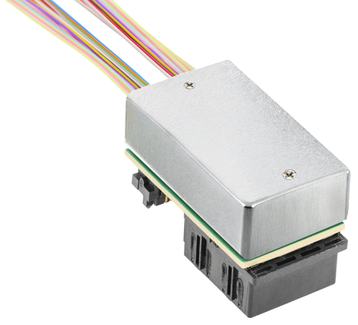
The Vesta also provides access to an open, standards-based CPO ecosystem that integrates a pluggable CPX electrical interface and an IEEE 802.3dj-compliant optical link. This enables an interoperable supply chain that supports collaboration across multiple ASIC, optical, and electrical interconnect vendors.
“We’re delivering the industry’s first truly flexible, open pluggable optical engine, removing barriers to CPO adoption and giving our customers exactly what they’ve been asking for: greater density, power efficiency, and reliability – all in an open, multivendor ecosystem," Dino DiPerna, SVP of global research and development at Ciena, commented. "We continue to innovate in response to evolving customer needs, allowing operators to scale AI clusters more efficiently, using less energy and space, while lowering overall infrastructure costs.”
The networking firm’s new release comes after its acquisition of optical technology developer Nubis Communications in an all-cash deal worth $270 million. Ciena framed the deal as complementing Ciena’s existing high-speed interconnects offerings, furthering the firm’s efforts to capture AI-driven data center demand.
David Rothenstein, SVP and chief strategy officer (CSO) at Ciena, recently suggested more deals are on the horizon, but only within reason.
“I think we have been very thoughtful deployers of capital on an organic basis, but why we do M&A [is] to bolster our position in the core business, to accelerate our position in an adjacent business, fill in gaps from a technology or go-to-market standpoint, drive cost and revenue synergies, or ideally, some combination of all of the above,” Rothenstein said. “That was behind the Nubis acquisition, behind a lot of the ones we've done in the past.”






Comments