

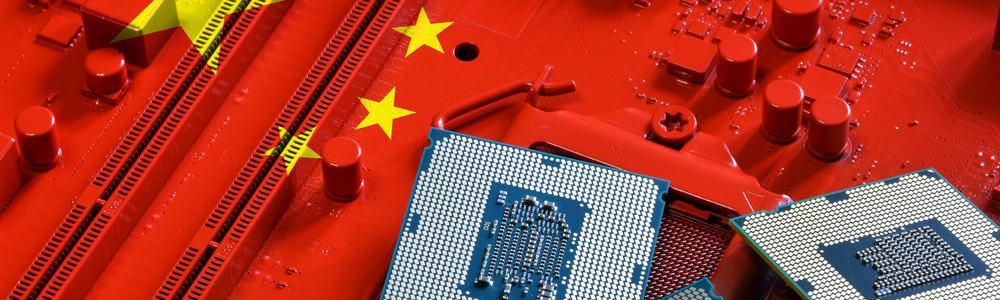
Chinese chipmakers are aiming for 80% semiconductor self-sufficiency by the start of the next decade as part of an ambitious push to secure supply independence.
Nikkei Asia reports that some 13 local market leaders have signed onto the pledge for semiconductor self-sufficiency by 2030, as part of a five-year plan to bolster their own semiconductor market amid increasing restrictions from the U.S.
Chief among the proposals is a plan to create its own version of what Dutch semiconductor giant ASML currently produces: the extreme ultraviolet lithography (EUV) machine maker that the entire semiconductor industry relies on.
ASML CEO Christophe Fouquet previously said that China would need “many, many years” to develop rival systems, with virtually every major chip manufacturer relying on the Dutch firm to produce the photolithography machines vital for making integrated circuits.
Fouquet’s comments haven’t deterred Chinese chip leaders, who are set to press on with plans for a homegrown rival to address an industry that’s “small, fragmented, and weak,” according to an article penned by the executives from Naura Technology, Empyrean, and Semiconductor Manufacturing International Corporation (SMIC), per the South China Morning Post.
Since SMIC’s 2018 efforts to purchase an ASML EUV machine were blocked by the U.S. government, China has sought to instead develop its own.
There have been reports of old ASML machines being reverse-engineered in Shenzhen, resulting in an apparent prototype being completed late last year, though it has reportedly yet to yield successful outcomes.
Firms like SiCarrier and Beijing U-Precision Tech are among the Chinese firms working to create nano-scale ultra-precision technologies. SMIC is believed to be testing deep ultraviolet (DUV) immersion lithography machines from a Shanghai-based company called Yuliangsheng, though those efforts look to have only gotten down to the 28-nanometer (nm) level. ASML’s systems, meanwhile, can produce semiconductor nodes down to sub-7nm levels.
To fuel the Chinese chipmakers’ dream of building the country’s answer to ASML, the execs claimed it would require a unified national effort, with pooled financial resources.
The comments were timely given that semiconductors and AI were identified as essential for strengthening China’s economic development under the country’s recently approved 15th Five-Year Plan.
In addition to lithography machines, Nikkei Asia reports the chipmaker’s plans also extend to memory, with the Chinese firms vying to push for long-term self-sufficiency amid a global shortage.
China is subject to U.S. export restrictions of semiconductors, with the Trump administration green-lighting Nvidia to offer China-specific H200 GPUs. Lawmakers are also looking at adding memory to chip controls in light of global shortages of dynamic random access memory (DRAM).
In light of the restrictions, China wants local firms to use local solutions, with its all-powerful Cyberspace Administration of China (CAC) internet regulator banning domestic technology companies from buying Nvidia AI chips last September.
That hasn’t stopped some Chinese companies from getting their hands on Nvidia’s higher-end hardware, as three people – including Supermicro co-founder Yih-Shyan “Wally” Liaw – were recently charged for allegedly conspiring to smuggle chips into China.
Reuters reports suggest Chinese universities with links to the country’s military were among those believed to have skirted U.S. sanctions and obtained Supermicro servers.
Liaw has since resigned, with Supermicro itself not named in the indictment, and is actively cooperating with investigators.





Comments