

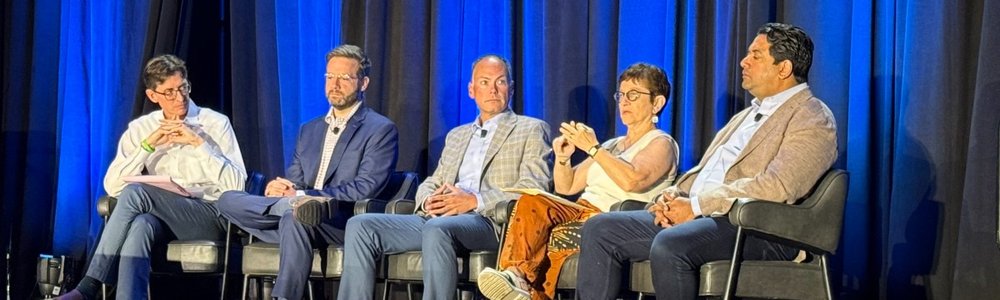
(L-R): John Wilkins, Quadra Partners; Evan Feinman, Former BEAD Director at NTIA; Kevin Gallagher, Former Senior Advisor to Commerce Secretary Gina Raimondo; Gigi Sohn, Executive Director at AAPB; Veneeth Iyengar, Executive Director at ConnectLA.
DENVER – The National Telecommunications and Information Administration’s (NTIA) current moves toward revamping the $42 billion Broadband Equity, Access, and Deployment (BEAD) program could be significantly impacted by the tangential boom in data center expansion.
Panelists during a keynote discussion at the recent Mountain Connect event quarreled over what sort of reliance BEAD-funded future broadband expansion should have on growing data center construction. Some reports have tagged the cost of that construction to support growing AI demand at more than $7 trillion.
Kevin Gallagher, who served as a senior advisor to U.S. Commerce Secretary Gina Raimondo during the creation of the BEAD program, noted during the panel discussion that the surge in data center construction to support advanced AI services will force the expansion of fiber-based broadband infrastructure.
“You cannot have a data center in your region without fiber,” Gallagher said, adding that this need will be exacerbated with the development of new AI services that will require a deeper and broader fiber footprint. “If I were still in the Commerce Department, I would be saying we need to use this money to build fiber because that’s how you're going to get AI and data centers in rural America.”
However, Gigi Sohn, executive director at the American Association of Public Broadband (AAPB), pushed back on this notion, stating it’s the wrong path to connect data centers with broadband expansion.
“If we keep arguing about data centers, if that's our best argument, we're never going to win,” Sohn said. “There's a lot of controversy around data centers in this country. People who live near data centers hate them. They have huge environmental impacts. We have to talk about the impact on people's everyday lives. … It's great to have this technological conversation about data centers, AI, but … if you're trying to move public opinion that’s not going to work.”
Evan Feinman, former BEAD Director at NTIA, countered Sohn’s assertion, stating that the data center connection is more about riding the wave of broader economic interests.
“I think the bridge between those two is, look, if I'm in a rural community that doesn't get broadband, isn't going to get broadband, I'm going to say, ‘listen, you all have been left behind before, you're going to get left behind again. The folks in the cities are going to have access to this AI technology. You're not,’” Feinman said.
Feinman further heightened the conversation by stating “it is a luxury for the communities that don't like data centers to not like data centers.”
“It costs the same amount to run a third-grade classroom and five kids in it as it does run a third-grade classroom and 30 kids in it. That data center that shows up and pays taxes and doesn't require a ton of public services is a godsend to that rural county, and with adequate infrastructure we could stop overburdening the communities that have too many data centers and spread that around,” Feinman said. “We’ll both have positive economic impacts in short term and long term, we'll offer economic opportunity to those communities.”
The most relevant response came from Veneeth Iyengar, executive director for the state of Louisiana’s ConnectLA broadband program, who explained that Meta’s recently announced data center campus that will be constructed in that state included plans to expand BEAD-funded broadband connectivity.
“What we also did was we actually also plotted out within a five- to 10-mile circumference of that data center, how many BEAD-eligible locations are there. … What we projected was that there were close to 1,000 households and small businesses that currently do not have internet,” Iyengar said. “From the Governor's perspective … his thought process is how we can use the best of the infrastructure as an asset enabler, as a platform to drive Louisiana success. And so, if data centers, which it is going to be, I think, a bigger play just given the energy and other resources of Louisiana that exist, how do you start to marry those investments with BEAD out to locations with workforce development to create a better educated workforce.”
BEAD program revamp coming
The BEAD program was initiated in 2021, and was part of the federal government’s $65 billion Infrastructure Investment and Jobs Act (IIJA). The BEAD funds are targeted at expanding broadband networks to unserved and underserved areas and to provide ongoing financial support to increase access.
NTIA was instructed earlier this year to revamp the program with a “tech-neutral approach” that by “removing the preference for a single technology will bring the full force of the competitive marketplace to bear and allow American taxpayers to obtain the greatest return on their investment.”
The previous mandate did not specifically point to a single broadband technology, but was noted by some as being heavily focused toward fiber as the transmission medium. Fiber has been touted by supporters as the most efficient technical way to provide the highest possible data speeds.
The new NTIA rules do maintain the need for approved broadband services to provide at least 100 Mb/s of uplink speed and 20 Mb/s of downlink speed. This does open up options for cheaper-to-deploy fixed-wireless access (FWA) and satellite broadband services.
However, recent updates by satellite broadband giant SpaceX, which is controlled by current/one-time President Donald Trump supporter Elon Musk, could make that option a compelling choice. This includes a recent push to provide free equipment to some low-income users, which tackles one of the long-standing hurdles for satellite-based broadband connectivity.
Jeff Heynen, VP of broadband access at Dell’Oro Group, previously explained to SDxCentral that one of the likely side effects of the pricing and technology changes is that it could lengthen the approval process. Heynen pointed to states like Louisiana, which had already moved through their approval process, but now will be required to re-open applications toward meeting the new low-cost objective.
“I think they just wanted guidance, and they wanted to get shovels in the ground and these projects going as quickly as possible, because their mandate was to solve the digital divide,” Heynen said of how states are likely to be viewing these program changes. “They went through an election cycle, a lot of the makeup of the governorships and the state broadband offices changed, so maybe there was some pushback during that change, but I'm not aware of it.”



Comments