

Broadcom bolstered its networking portfolio with a trio of updated platforms targeted at the home gateway, Wi-Fi 8, and fixed-wireless access (FWA) market.
The first update is a new 50 Gb/s (50G) passive optical networking (PON) gateway system-on-chip (SoC) designed to help operators support growing AI-driven traffic and connected home applications. This is through support for low-latency edge processing, intelligent optimization, and multigigabit fiber connectivity.
The BCM68850 includes an integrated neural processing unit (NPU) and native Wi-Fi 8 compatibility, though that last feature is subject to actual Wi-Fi 8 specifications being ratified. The 50G PON capabilities allow the design to process and transmit large data payloads, which can free up the compute and transmission resources to deal with larger amounts of traffic.
The platform also includes “intelligent self-healing” that allows operators to use real-time anomaly detection and predictive bandwidth optimization to help reduce opex, and post-quantum cryptography (PQC) security algorithms.
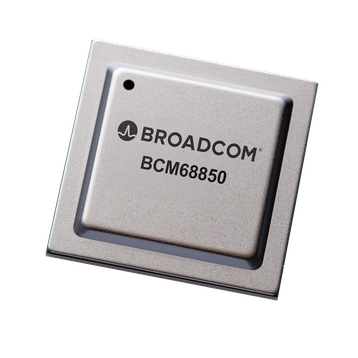
The offering also ties in with Broadcom’s edge-focused BCM68660 optical-line terminal (OLT) and BCM550550 optical-network terminal (ONT) or BCM68850 consumer premise equipment (CPE) gateway.
Broadcom’s Wi-Fi 8 SoC portfolio also gained three new entrants: BCM6772, BCM6774, and BCM6776. These are designed for Ethernet router and mesh network deployments.
The lowest numerical model is targeted at “mass-market Ethernet routers, extenders, and repeaters,” and includes integrated two-by-two (2x2) 2.4 GHz and 2x2 5 GHz radios; support for fourth-generation double data rate (DDR4) and fifth generation DDR (DDR5); and comes in a 15-by-15 millimeter flip chip ball grid array (FCBGA) package.
The middle numerical model goes for “high-volume Ethernet routers and extenders” with a similar lineup updated with a 4x4 5 GHz radio.
The high-end model has a larger 19x19 mm footprint with support for low-power DDR4 and DDR5 memory, and dual third-generation PCIe controllers that can be paired with Broadcom’s BCM6718 radio for triband support.
Kevin Narimatsu, associate director for product marketing at Broadcom, explained in an interview with SDxCentral that Broadcom “took a very conscious decision to provide as much memory flexibility into these solutions.” This includes the ability to support two generations and four variants of memory: DDR4, LPDR4, DDR5, and LPDR5.
“Our customers are telling us this is really critical from a flexibility,” Narimatsu said. “No one's going to be able to predict where memory is going to be in six months or a year, so we wanted to give that maximum flexibility. If you're kicking off the design and you know next year you're locked into DDR4, you know that could be extremely challenging from delivering a full solution at a cost point, that's going to be cost effective, so providing all this flexibility. You can make the decision later on as DDR5 comes online, and if that supply is better then you can kick off designs with that configuration versus being stuck in an old memory that has cost challenges and supply challenge.”
Some Broadcom customers have noted this flexibility.
Extreme Networks CEO Ed Meyercord recently touted Broadcom for help in securing memory chips.
“We've been able to establish direct connections, establish distribution relationships through our relationships here in the U.S. to get commitments,” Meyercord told SDxCentral of this Broadcom work, adding that Extreme has also garnered support from other component suppliers like Micron and Samsung.
“Micron is severely squeezed in what they can do,” Meyercord explained of the Micron example. “The Micron guys work with us to work with Broadcom to qualify memory designed for the automotive sector that we can then put in our access points and our switches, and then we've been out canvassing for these different kind of memory chips that are now qualified and work for us.”
Broadcom’s Narimatsu also labelled these as the vendor’s “fifth wave” of Wi-Fi 8 SoCs. This comes just a month after the previous wave that was targeted at the service provider market.
“The fifth wave is really for a fully integrated, like a dual-band or dual-band router or extender, and then we are able to support a triband configuration with one extra chip, so two chips for triband,” Narimatsu explained.
Samsung FWA partnership
That high-end Wi-Fi 8 model also ties into Broadcom’s new integrated FWA product launched with equipment vendor Samsung.
Samsung’s contribution is in the form of its B1320 radio that supports 3GPP Release 17 specifications; four-receive, two-transmit radio chain support; power class 1.5 support for time division duplex (TDD) spectrum bands; LPDDR4x and LPDDR5x memory; a 1.6 GHz quad-core Arm Cortex-A55 central processing unit (CPU); and satellite connectivity.
Gabriel Desjardins, director of Broadcom’s Wireless Connectivity Division, explained that the vendor has been in the fixed-wireless market using platforms from Qualcomm and MediaTek, moves “driven by OEMs presenting platforms for customers,” but “we wanted to have more of a real platform in that space.”
Desjardins noted that Broadcom has been working with Samsung, including the previous generation that included support for the 3GPP Release 16 specification, with the new one now supporting Release 17.
“What we are seeing is that between the cost optimization of the Broadcom Wi-Fi SoCs and the cost optimization that Samsung has done on their side, we're coming into this market with a very competitive platform for pretty much all opportunities,” Desjardins said, though he later clarified that those opportunities are for something priced above high-end specification needs and at a more attractive price point.
“If you go to say Verizon and you buy a 5G CPE, that's a super high-end product, and Qualcomm and MediaTek have designed high-end chips for that, and so the cost of the Qualcomm and MediaTek platform is very high, and there's only a handful of those operators in the entire world who actually need that high-end performance … really Verizon, AT&T, T-Mobile, British Telecom, Deutsch Telecom, those are really the five players in the world – maybe somebody in Japan – who need that ultra-high end special chip. Everybody else can function with a slightly reduced version,” Desjardins explained.
“The slightly reduced version that's doing the most business in the market is the Qualcomm X61, which is several generations old and only has [Release 16] support," Desjardins continued. "What we're seeing is that we're coming in at a lower cost than competitor platforms, and we are exceeding the specs on those low-end to mid-tier platforms, so there's a lot of interest in this FWA platform worldwide. … Definitely for 5G backup opportunities, even 5G CPE opportunities outside the U.S., U.K., and Germany.”
Desjardins added that specific to the U.S. market the new Broadcom platform is targeted at use cases deployed through the Comcast Storm Ready and Charter Invincible Wi-Fi. These are at-home Wi-Fi routers that include back-up cellular connectivity in case of a cable internet outage.
“Those things are rarely connected to the network, so they don't need quite the same cell efficiency. Desjardins said. “It's SKUs like that that exist worldwide, but also there are plenty of countries where they do want a CPE that's permanently connected to the network, but they're much more concerned about costs. In Europe, the amount of money that a subscriber is willing to pay for equipment is significantly lower than it is in the U.S. and so you you'll see operators there looking toward more of these mid-tier platforms.”
That could also include integration with other cellular radio providers.
“Obviously … we don't have 100% control over how these platforms get pulled together, so there will still be cases where an OEM or an operator will say, ‘OK, Qualcomm modem, Broadcom Wi-Fi; MediaTek modem and Broadcom Wi-Fi; or even UniSOC modem, Broadcom Wi-Fi.”
Broadcom unwavering on Wi-Fi 8
Broadcom’s latest offerings capitalize on its claim of offering “industry first” Wi-Fi 8-ready silicon solutions. This despite the forthcoming IEEE 802.11bn networking standard (Wi-Fi 8) not expected to receive final approval until 2028.
Despite the uncertainty, Narimatsu said that the vendor continues to see significant demand for its Wi-Fi 8 products “even faster than previous generations.”
This is being led by retail, with service providers “right behind retail. They're not as fast, but really in this cycle we're seeing that they're almost as aggressive, pushing us very hard to launch as quickly as possible,” Narimatsu added.
Dell’Oro Group Research Director Siân Morgan recently penned an Industry Views column for SDxCentral predicting more than half of the enterprise market will have shifted to Wi-Fi 8 by 2032.




Comments