


Nearly every conversation I have with a Gen Z’er includes some version of: “When I was in school, I looked everything up in an encyclopedia, with actual paper pages!” because really, I’m struggling to adjust to the way technology has altered our lives. The journey from sending that first work email over the air in the 1990s to using ChatGPT to prepare my slide deck is a blur.
The breakneck speed of innovation is partly due to what the World Economic Forum calls the 3C framework, in which new inventions layer on top of prior technologies adding value in unforeseen ways. Uber on GPS capability, VR headsets on advanced sensors, the power of compounding doesn’t just work in your savings account; it also works with technological innovations.
Let’s take Wi-Fi as an example. It was introduced in the 1990s as a method of connectivity that worked best for text-based emails. If you wanted to transfer an image, you reverted to an Ethernet cable. Today, young people think that Wi-Fi is synonymous with the internet, and poor-quality Wi-Fi causes as much of a disruption as an electricity blackout.
Wi-Fi technology is so successful that the Wireless Broadband Alliance estimates there are more than 20 billion Wi-Fi capable devices in the world. It has become ubiquitous in the workplace, in the educational system, and in entertainment venues worldwide. Business revenues depend on high-functioning Wi-Fi, in fact, the WBA estimates that Wi-Fi generates more than $4 trillion of economic value.
Like most technology, newer versions of Wi-Fi have layered one on top of the other, with each generation of the IEEE’s 802.11 specification bringing innovations. This year will be a boom year for the latest commercially available version: Wi-Fi 7. In 2025, about a quarter of enterprise-class access points (APs) sold were Wi-Fi 7, but the take-up is accelerating, and by the end of the year adoption will have doubled.
We should not be surprised that just as enterprises are being introduced to Wi-Fi 7, component developers are announcing plans for Wi-Fi 8.
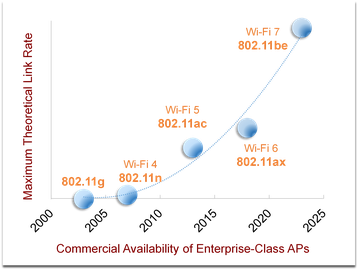
It’s legitimate to wonder whether we really need another Wi-Fi version. Isn’t Wi-Fi great already? If you look back at the increased bandwidth that the last few versions have provided us, you quickly realize that we’ve got all we can use.
The next innovations in Wi-Fi will have to deliver more than raw speed. Wi-Fi 8 will be introduced into a world of agentic AI, cybersecurity threats, and robotic workplaces. We’ve solved the problem of sharing videos over radio waves. The next challenges are more complex and require new innovations to address.
Wi-Fi 8 specifications have not yet been finalized, but the dedicated brainiacs working at the IEEE are hammering out the details, and we have a good idea of the improvements to expect:
- Consistent, high-bandwidth performance across a wider variety of real-world conditions
- Elevated uplink speeds
- Better performance moving between APs
- More efficient use of available spectrum
- Lower latency for applications that are time sensitive
- Higher power efficiency on both APs and devices
Is every enterprise going to find one killer feature in there, the one that will cause them to ditch all of their older Wi-Fi 7 gear and buy the latest Wi-Fi 8? Unlikely, because that’s not how the market works.
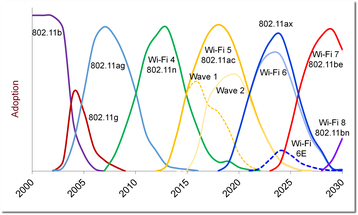
Looking back at historical Wi-Fi adoption shows us how the market will unfold. First, devices will begin to support the new standard. This necessary step was one that hindered Wi-Fi 6E uptake. Many device makers chose to skip directly from Wi-Fi 6 to Wi-Fi 7, and the adoption of Wi-Fi 6E remained low until Wi-Fi 7 took over.
Next, component providers and system vendors will begin to stop supporting older versions of Wi-Fi. Companies only have so many developers, and as they focus on the new standards, they need to move staff away from developing patches on older technology. This means that in 2028, when the first Wi-Fi 8 enterprise class APs come to market, organizations that are still using Wi-Fi 5 APs are going to have to plan on renewing the network to ensure their technology is fully supported.
Once enterprises are committed to replacing their outdated Wi-Fi, they will tend to move to the latest specification, even if there is a modest price premium over older versions. Why? Because the new business reality includes heightened requirements: for the volume of traffic, for the performance of the connection, for the security of the network, and for the automation of operations. Technology is moving so fast, enterprises need to invest in the latest versions to ensure they are well placed to compete in the upcoming years.
Gradually, from 2028 onward, Wi-Fi 8 adoption will grow as enterprises ditch their older gear. At that point, organizations using Wi-Fi 6 or earlier versions are in for a significant improvement if they are in regions of the world that have approved the 6 GHz band for Wi-Fi use. Access to this new band was introduced with Wi-Fi 6E and has a marked improvement on Wi-Fi performance.
By 2032, more than half the enterprise market will have shifted to Wi-Fi 8, and we can begin anticipating Wi-Fi 9. Does it seem relentless? Yes, but by looking back at history we see that this flywheel cycle brings incremental improvements at every turn. What’s next, holographic humanoids fed by energy harvested from the environment? The sky is the limit to human ingenuity.




Comments