


Amazon Web Services (AWS) has made its Graviton5-powered Amazon EC2 M9g and M9gd instances generally available, positioning the processor as infrastructure for a new generation of AI workloads that place growing demands on CPUs alongside GPUs and other accelerators.
First previewed at AWS re:Invent 2025, the new instances are powered by the AWS Graviton5 processor and built on the sixth-generation AWS Nitro System. AWS said the processor is designed to support emerging agentic AI workloads involving real-time reasoning, code generation, and multi-step task orchestration.
AWS argues that agentic AI systems place growing demands on CPUs as they coordinate large numbers of concurrent tasks, manage context, orchestrate model interactions, and move data between AI accelerators and enterprise applications.
The hyperscaler said Meta plans to deploy tens of millions of Graviton cores for its agentic AI initiatives, while Uber and Snowflake are also adopting the platform for AI-related workloads. More than 120,000 customers currently use Graviton-based infrastructure, according to AWS.
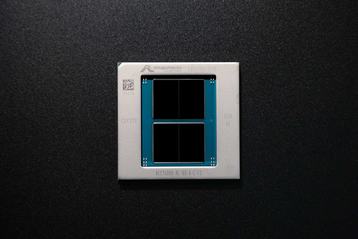
Graviton5 doubles the core count of its predecessor from 96 to 192 cores and introduces support for DDR5 memory and PCIe Gen 6. AWS said the processor also features more than five times the L3 cache of Graviton4 and delivers 33% lower inter-core latency.
AWS said the new M9g instances deliver up to 25% higher compute performance than the previous-generation Graviton4-based systems, including up to 35% faster web applications, 35% faster machine learning inference, and 30% faster database workloads.
For storage-intensive applications, AWS is also introducing M9gd instances, which offer up to 11.4TB of local NVMe SSD storage and up to 30% higher IOPS than the previous generation.
The processor incorporates several architectural changes intended to improve performance and efficiency. Graviton5 is manufactured using Taiwan Semiconductor Manufacturing Co.'s 3nm process technology and adopts a redesigned chiplet architecture that distributes compute resources across four chiplets rather than a single compute die.
AWS said each chiplet includes its own DDR5 and PCIe controllers, reducing the distance data must travel between processors and memory resources. The company said the changes contribute to improvements in both performance and energy efficiency.
The new instances are also the first to incorporate the Nitro Isolation Engine, a formally verified security component within the latest AWS Nitro System. AWS said the technology provides mathematically verified isolation between virtual machines.
The M9g and M9gd instances are available immediately through standard EC2 deployment options.





Comments