


“No one thing in and of itself is something to rest on,” AT&T CEO John Stankey told the audience during the opening keynote at Mobile World Congress 2026, as he set out a bullish vision for the company’s push across 5G, satellite, and hybrid networks.
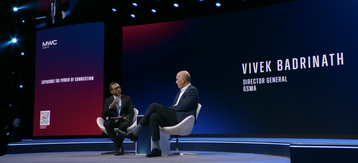
During a fireside chat with Vivek Badrinath, the director general of event organizer GSMA, Stankey stressed the need for firms in the telecom space to not rest on one thing for too long, opining: “When it's time to make the shift or the pivot, make it.”
AT&T is one of the industry players certainly looking to shift. Some 150 years since the company’s forebear Alexander Graham Bell made the first telephone call, it finds itself spread across 5G, dense fiber networks, and direct‑to‑device satellite.
But while a sizable portion of the industry battles to successfully commercialize the first of those three things, Stankey said the U.S. market has gotten “over that hump” when it comes to 5G.
“One of the things that's oftentimes brushed over is what 5G did in the consumer space to make more effective use of spectral efficiency, and what that did in opening up new markets for just simple things like fixed broadband that has driven an awful lot of innovation, both in the consumer market and in the backup business and primary for business customers,” Stankey said.
Beyond the consumer space, Stankey said that the rise of 5G standalone (SA) is making inroads in the enterprise space.
“We see enterprises doing things on their factory floor to get dramatically more improvement in efficiency. We're seeing hybrid networks pop up, public and private, that make sense," Stankey continued. “We're doing things over wide open spaces, whether it be studio lots or what happens at a sporting venue, to be able to connect video cameras so that they can actively get on a network and move without restraint. So I think we're over the hump on those types of things now, and the innovation can start taking shape, even to a greater level.”
5G: Moving beyond the hump
In addition to 5G, fiber has a key role to play in the next wave of connectivity at AT&T, with Stankey repeating his view that the industry is not siloed as fixed and mobile, but instead as “dense fiber networks with different access technologies hanging off of the fiber.”
“My personal belief is we're seeing that play out right now,” the CEO said. “If you're going to offer, ultimately, an integrated solution to a customer, that's going to be essential from a customer's perspective.
“There's one internet [and] they don't want to buy it multiple times," Stankey continued. "They'd like one relationship. … And if you're going to meet that expectation with a customer, you're going to have to have dense fiber infrastructure and be really good at running multiple access technologies off that fiber infrastructure.”
Stankey told the crowd that the U.S. market was seeing “very robust intermodal competition” with satellite also coming to the fore as part of that converged stack, adding: “Whoever does that the best ultimately will probably do well in the markets.”
Bullish on satellite connectivity
AT&T has already made strides to bring satellite connectivity as part of its dense network, opting for AST SpaceMobile, where some of its rivals have instead gone to Starlink. AT&T recently came up trumps to benefit from EchoStar’s exit from the commercial cellular space.
Stankey used his platform to bullishly back satellite as part of AT&T’s next frontier, touting its potential as “one of those great moments of innovation for the consumer, for businesses, and for the industry.”
“It is clearly going to open up some uncharted territory that we're all going to have to work our way through. But I think the promise of it is just so amazing," Stankey said. "We should all be thinking about how do we bring that promise to our customers? And I can think of no group of companies that are probably better positioned to figure out how to do that than the ones that already have significant relationships with our customers.”
Stankey told MWC that the race is on then between AT&T and its rivals (the likes of T-Mobile US and Verizon) to be the best at running a truly hybrid network and bring that next layer of connectivity in and “do it in a way where the customer doesn't even have to think about it.”
When asked about his ideal view of what satellite connectivity would look like, Stankey said: “There should be multiple constellations in the sky, not one. And I think that to the extent that all of us manage our businesses and think about it that way, that will be an outcome that allows us to make sure we do things the way that we can continue to have a role with the customer moving forward.
“I think we shouldn't be fearful of it," Stankey added. "Frankly, I think we should embrace it. I know in my business, we invest a substantial amount of money and have for decades to serve customers inside of high rises, hospitals, stadiums, [and] in homes with a better, higher bandwidth, lower latency, lower marginal cost infrastructure to the extent that we take those advantages and use them effectively, I think we bring a better solution to the consumer, and I'm optimistic and bullish about that.”

AI driving dynamic network management & pricing
Satellite wasn’t the only complementary technology the AT&T CEO talked about in Barcelona, with AI naturally rearing its head as a talking point.
Having previously hyped its software-led efforts to overhaul its network, Stankey said AI was front and center in how the carrier was running and securing its network to provide both efficiency gains and a competitive edge.
“We're all running our call centers more efficiently using AI, getting better responses from our customers because of the choices we give them, and we're all writing more code faster," Stankey explained. "In our case, we're approaching nearly a 40% improvement in efficiency and effectiveness, and that not only is effective and efficient, but allows us to do more, bring more projects online than we've ever been able to do before that add value in the business."
While efficiency is a core tenet of adopting and implementing AI, Stankey said AT&T’s competitors were doing the same to the extent that “realistically, those efficiencies generally get competed away in the market,” and instead its efficiency gains were being used to take those savings and offer customers more value.
“That's the next step," Stankey said. "And so, using our data, our insights, what we know that somebody else doesn't know, I think that's the next great frontier. … You're starting to see really green shoots in areas like how we dynamically manage the wireless network to respond to loads and traffic, and what we're able to do to dynamically allow AI to realign antennas, move capacity in different areas.
“We're also working actively in pricing space," Stankey added. "When you start thinking about what we know about a particular building, particular location, the number of competitors, the amount of fallow capacity we have in an area and being able to dynamically price that so you get to a yield construct, allows us to be a lot more effective in the market, in places where we typically would maybe not have gone on pricing before.”
Why U.S. reinvestment trumps European expansion
Rounding out the conversation, Stankey faced a left-field question from the GSMA chief: If AT&T is so successful with its 5G efforts and converged stack providing gigabit-scale connectivity to millions of Americans, why not expand into Europe?
The CEO answered the question by saying that factors ranging from policy consistency to market dynamics make reinvestment in the U.S. more attractive than expanding to Europe.
“Every spare dollar I have, I'd rather go more deeper into the U.S. to make sure I have that pervasive fiber footprint that I can hang different access technologies off of than trying to figure out a new dynamic,” Stankey said.
“There's been little bends and curves along the way, but [regulation] has been largely light touch," Stankey noted of the U.S. environment. "Had there not been that consistency, we wouldn't have arrived at this moment right now where we see this massive amount of intermodal competition going on in the U.S. Every dollar I have right now, putting it back into the U.S. market is my first choice because it is a very attractive construct.”





Comments