

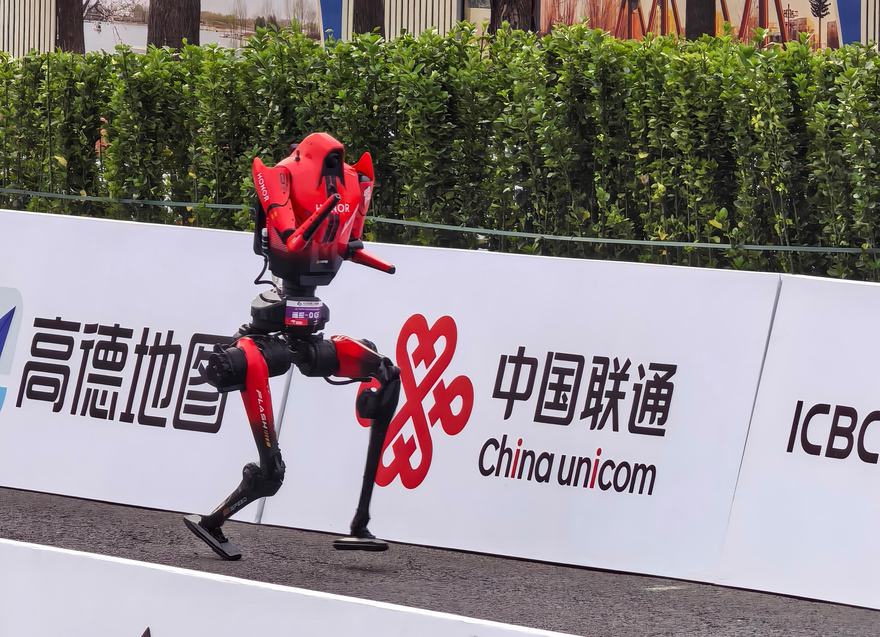
Playing host to the Beijing E-Town Half-Marathon and Humanoid Robot Half-Marathon 2026, on April 19th, the Daxing District saw human and robot runners compete simultaneously in a race to the finish line – resulting in a humanoid robot smashing the (human) world half-marathon record by a whopping seven minutes.
Underpinning the success of the event – not just the robots – was China Unicom and Huawei’s 5G-A GigaUplink network, which provided not only fast uplink with huge capacity and low latency for event organization and media services, but digital engagement too, bolstering participation for humans and humanoids alike.
China Unicom and Huawei provided an elevated experience for all by turning to 5G-A 3CC on 3.5 GHz and 2.1 GHz for the event. This ensured an uplink fulfillment of 20Mbps, surpassing 99.6 percent, along with a peak speed of field-tested 677Mbps – providing consistent, reliable support for 4K/8K HD broadcasting, real-time data collection, and editing, while also enabling fans to share and stream seamlessly.
But a high-quality network was only one piece of the puzzle. To guarantee the flexible operations required for such a fast-paced event, China Unicom and Huawei leveraged intelligent base stations to build elastic 5G-A channels. This made it possible to facilitate differentiated scheduling for livestreaming, voice and video calling, as well as short videos to ensure an uninterrupted experience for participants, even in moments of heavy traffic.
Off to the races
To complete a half-marathon, humanoid robots – who for this race were divided into two groups: those with autonomous navigation, and those with remote control – require very high stability, reliability and endurance, not unlike their human counterparts. From their joints and the soles of their feet to fast battery change technology, every aspect of these machines is designed to optimize performance.
And when it comes to embodied AI, it’s not just about the hardware, or the network for that matter. Innovative algorithms are just as crucial, in this case to necessitate reliable high-speed running control, high-precision positioning, as well as dynamic obstacle avoidance and navigation, all of which needed to be honed over multiple rounds of testing and training to identify any practical problems or safety issues prior to race day.
With each robot on the track requiring an uplink speed of around 10Mbps in order to perform as required, combined with a live media broadcast as well as connectivity requirements from the crowd, China Unicom didn’t cut any corners, having comprehensively upgraded its network since supporting the World Humanoid Robot games in August last year.
This year, China Unicom deployed its 5G-A premium network with high uplink speeds along the core track, adopting cutting-edge carrier priority technology in the densely populated areas at the start and finish lines to deliver a peak uplink speed of 677Mbps and an average uplink speed of 155Mbps.
With end-to-end latency as low as 30ms on average, this also guaranteed consistent and stable connectivity, enabling the robots to achieve precise perception, rapid decision making, and efficient movement while navigating the complex course. This was exemplified during a comprehensive simulated road test, which saw the robots reach speeds of up to 10 meters per second, far surpassing that of the average human.
Elevating the event
Not only could spectators enjoy the event from their own perspective, thanks to 5G and AR/VR technologies, they could view it from the robots’ point of view too. This dynamic experience was again down to the network underpinning the event platform, where event data, robot performance and track conditions were updated in real-time, so spectators didn’t miss a moment and organizers had efficiency they could depend on.
This highly reliable, all-weather user experience was further enhanced by an ICT-integrated smart operations platform, which enabled visualized management of the entire network, encompassing intelligent scheduling, millisecond-level fault prediction, and dynamic optimization of network resources.
Essentially acting as the brains of the operation, this intelligent operating system utilizes AI algorithms to enable automatic monitoring and remote optimization of communications equipment. By combining dynamic and static management, the system was able to achieve adaptive network operations for uninterrupted, 24/7 network O&M, even in scenarios where humans were unavailable.
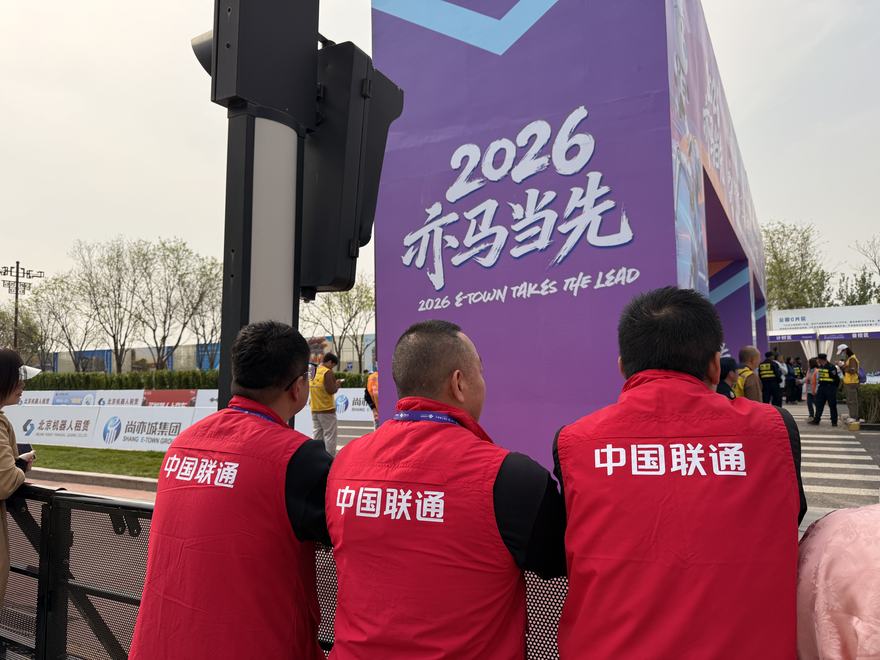


In addition to providing technical support, China Unicom and Huawei’s intelligent high-uplink 5G-A network is serving to reshape robot marathon events overall, through advancements in AI-powered competition modes and user experience, setting a new benchmark for the integration of technology, sports, and industry.
“5G-A and AI are essential digital infrastructure, enabling us to bring embodied AI to sports,” said Qin Yang, deputy general manager of China Unicom in Beijing.
“Given the new dynamics of AI development, we will double down on our priorities over connectivity, computing power, services, and security to sharpen our competitive edges as a preferred telecom partner for intelligent sports and a core enabler for intelligent industry transformation. Moving forward, we will accelerate our innovation-driven push to strengthen our digital infrastructure and drive the high-quality growth of embodied AI in China and beyond.”
Accelerating automation
As the development of mobile AI pushes us further into the future, mobile networks are shifting from being downlink-dominant, to placing equal emphasis on both uplink and downlink. Scenarios like embodied AI, industrial data backhaul, AI terminal interaction, and immersive entertainment are increasingly demanding Gbps-level ubiquitous and deterministic downlink experiences, in tandem with high uplink bandwidth. High uplink has therefore become an industry consensus, with ubiquitous 20 Mbps emerging as core indicators of uplink network capabilities.
Supported by multiple core technologies including ELAA, 3.5 GHz and 2.1 GHz bands, and 3CC aggregation, 5G-A is capable of bringing AI services everywhere with “0 Bit, 0 Watt, 0 Loss” technology, also supporting low-carbon operation. This combination of high-speed, low-latency functionality means the network requirements of embodied AI can be (quite literally) met in the moment, accelerating wider breakthroughs in humanoid robot autonomy.
Citing this humanoid robot half-marathon as a prime example of the deepening integration between mobile technology and embodied intelligence, Samuel Chen, vice president of Huawei's Wireless Network Business Marketing, commented:
“Beyond redefining connectivity for sports, it has shown us what intelligent production and life will look like in future. We are always dedicated to building excellent 5G-A networks together with operators based on user-centered innovation to ensure GigaUplink, low latency, and high reliability for differentiated mobile AI services. This will enable us to continuously drive the high-quality growth of the digital economy."
This demonstration of unrivalled connectivity through collaboration is helping evolve embodied AI from a tool to a partner, ultimately enabling deep integration across production, healthcare, research, and gradually, our everyday lives.
More from Huawei
-

Sponsored Huawei Cloud: The first choice of multicloud provider for LATAM enterprises to stay ahead in time
Huawei Cloud has become the go-to provider for businesses adopting hybrid and multi-cloud solutions
-

Sponsored Beyond telcos: Exploring deterministic paths to business success in the agentic era
The agentic era is creating unprecedented opportunities for the communications industry, and carriers are uniquely positioned to seize these opportunities
-
Huawei to operators: Don't wait for 6G, 5G-Advanced & 6 GHz can handle 'exploding AI'
ICT Business Group CEO says the first 6G standard is years away, pitching 5G-Advanced to refine legacy networks and protect 5G investments
Comments