

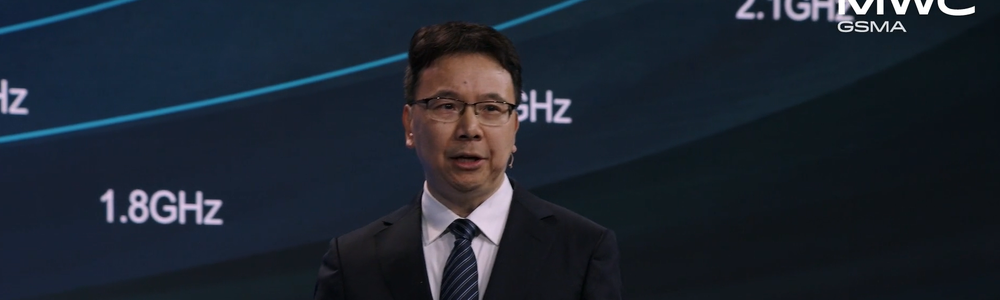
Huawei is downplaying the rush to 6G, with Chaobin Yang saying the first 6G standard is unlikely before March 2029, and urging operators and regulators instead to focus on 5G-Advanced and 6 GHz spectrum to handle exploding AI traffic in the meantime.
In a keynote presentation at Mobile World Congress, Yang, who serves as CEO of Huawei’s ICT Business Group, said that AI “will not wait” and that plain old 5G alone won’t be able to stem the tide of spiraling uplink and downlink speeds.
Instead, he pitched 5G-Advanced, underpinned by access to the upper 6 GHz spectrum band, as the real workhorse to support the rise of AI in the network if 6G were to remain on the horizon.
“AI will not wait for 6G; it will be introduced in today’s 5G network, 5G-Advanced network, and 4G network, which can provide more diversified network capabilities for the service,” Yang said.
Huawei has long touted 5G-Advanced as a means to push connectivity ever further beyond already widely adopted cellular standards.
Yang’s comments at MWC are not the first time a Huawei executive has pitched 5G-Advanced as a means to support network applications in the era of AI, with former Huawei rotating Chairman Ken Hu claiming early commercial rollouts of 5G-Advanced coincided with early AI adoption.
Some years on, though, the commercial 5G-Advanced market was estimated at around $15 billion in 2025, according to Market Report Analytics, and is projected to grow at a 25% compound annual growth rate (CAGR) from 2025 to 2033.
Building on that projection of growth, Yang told delegates that 5G-Advanced is already moving beyond the lab, noting that it is in “commercial scale in over more than 300 cities worldwide” and arguing that continued gains will depend on “introduc[ing] new spectrum and refining all of the legacy spectrum” to cope with AI-era traffic.
“Upper 6 GHz has been established as one of the primary bands for future mobile communication,” the Huawei exec said. “This band is becoming a global spectrum outside North America and will be the core spectrum for 5G-Advanced in the next five years. 5G-Advanced standard in 3GPP has already received support in upper 6 GHz, so the industry is mature [and] mainstream chipsets now fully support that."






Comments