

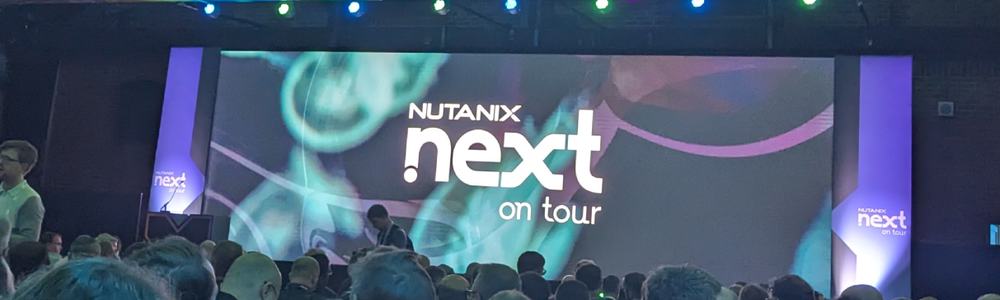
Let’s not beat around the bush. Hyperconvergence isn't sexy. It's boring. But let me explain to our dear SDxCentral readers how Nutanix aims to make it sexy – and yes, that’s a lot of “x’s” to put in one sentence.
At a recent Nutanix keynote, Adam Tarbox, Nutanix VP and GM for EMEA North, kicked off proceedings by talking about some sexy topics: digital sovereignty and AI. According to the VP, Nutanix’s proposition answered the key questions of where AI resides and who’s accountable, while also serving an increase in both portability and speed of release with more AI-infused apps.
The question, Tarbox said, is how to modernize enterprise environments without creating more silos, with the application estate “splitting in two worlds,” as he put it. Modern estates rely on containers and Kubernetes over virtual machine (VM)-centric workloads, and are defined by APIs and automation in driving those frequent software releases. Nutanix aims to “create a bridge” between traditional and modern estates, while also taming token usage and what CTO Manosiz Bhattacharyya referred to as “maniacal” AI agents let loose in the enterprise.

Positioned later in the keynote, Bhattacharyya’s presentation focused on all the bread-and-butter hyperconverged infrastructure (HCI) stuff: boxes and hardware and the like. Sitting in the audience for the event, I wondered if this was what the audience really came for. Surely no way an increasingly provincial backwater like the U.K. is that far ahead in the AI journey that companies are utilizing agents and tokens on a daily, intensive schedule? Nutanix’s cool AI pivot may be falling on deaf ears, I worried, and that's not even considering its status these days as a VMware alternative of choice. Do people want to hear about agents, or how they can potentially save money by weaning off Broadcom?
AI and isolated islands
To test my proposition I attended a customer roundtable where to my surprise one Nutanix client, electronic-gaming service provider Continent 8 Technologies, is actually using agents in its security operations center. Its CTO Edward O'Connor said they were introducing them slowly to its electronic-gambling client base in co-development.
Continent 8 is also using AI for support and response ticket automation by using a setup where containers and traditional VMs run side-by-side, which effectively exposes agents to Continent 8’s customers to run in their own environments.
“It runs on Nutanix as a Kubernetes-native application,” O’Connor explained. “It runs in the tenant, it has a sandbox environment. It gets specific access to data. You can control it as well.”
In another example of hype-made-reality, O’Connor endorsed Nutanix’s sovereignty pitch when discussing clusters and data regulation.
“They're almost like isolated islands because of the regulated nature of our business. So if I build a cloud cluster in Atlantic City that I provision clients onto, it only exists in Atlantic City. Even if that client is with me in 15 data centers, there will be individual clusters. I think one of the biggest benefits that we're going to get in the years to come through our investment … with Nutanix is it'll allow us to separate our management layer from our compute and worker layer in a very safe and regulatory-approved manner because the regulators have already certified us running this platform in data centers,” O’Connor said.
Supply chain is sexy
But let’s not allow all this topical talk to distract us from the fact HCI has been changing into something more alluring for a while now, something which Nutanix has arguably kept on top of.
Traditional HCI put compute and storage into the same cluster of standard servers. Today, this setup is becoming a disadvantage for certain workloads, e.g. AI (oh, I mentioned it again, sorry).
Anyhow, disaggregation is the real deal, with Nutanix increasingly positioning the software layer as a platform spanning on-premises infrastructure, public cloud, and multiple virtualization environments. Its hybrid-cloud strategy is to turn its HCI software into a common infrastructure layer that can run both in data centers and inside public clouds.
It’s not alone here. Sangfor Technologies, a VMware contender recently crowned as a virtualization “visionary” by Gartner, is deliberately moving away from marketing itself primarily as an HCI vendor because the addressable market for standalone virtualization is substantially larger than the market for conventional HCI.
This is according to its cloud business director Keith Lee, who told me in an interview following Nutanix’s event that the firm was not targeting large enterprise customers who favor three-tier architectures: server virtualization with separate networking and established storage platforms.
“They do not want to adopt the hyper converged solution, so we are moving more toward virtualization,” Lee said, while adding that, like Nutanix, it sees itself as an “AI gateway” player, using Gartner’s term for the middleware layer that bridges applications and AI models.
The ideal customer would be a smaller business like British insurance provider Markerstudy Group, if it wasn’t already snapped up by Nutanix.
At the Nutanix roundtable, Marketstudy CTO Nick Ovenden revealed its cloud provider, Microsoft, was now rationing access, requiring customers to seek specific approvals for additional resources.
“We are going to be coming up to a refresh period soon and one of the questions that is now being asked is, 'how is the impact on the supply chain going to affect what we put in there?' How is the associated costs, which we've been budgeting for the past three or four years, based on what we did know, now going to be knocked completely out of kilter?” Ovenden said.
Here, Nutanix helps by potentially reducing dependence on any single source of infrastructure capacity with its hybrid-cloud proposition. At the roundtable, chief revenue officer (CRO) Andrew Brinded said Nutanix expects supply chain challenges to last another 12 months, and echoed CEO Rajiv Ramaswami by seeing an opportunity to help with customers’ migration options.
“You're probably aware that our license is portable, so if a customer chooses to use us on-premises or chooses to use Nutanix as a conduit to the public cloud, then they can take that license with them. So it means that you've got agility," Brinded said. "And our software means it's really easy to migrate because we treat them all as just an individual data center."
Arguably, this is real music to the ears of firms like Markerstudy, who, according to its CTO, are not really working with AI at present and thus are a little tuned out of the Nutanix agent proposition.
In other words, Nutanix may be wise to pitch their next keynote around another sexy tech concept: supply chain issues and solving such constraints.
Who said hyperconvergence is boring again?






Comments