

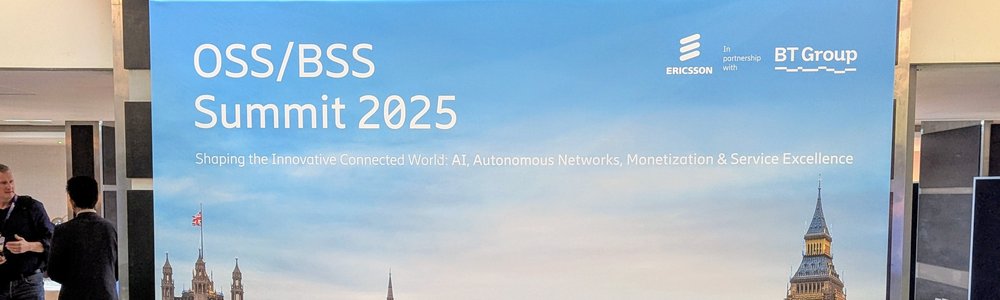
The Ericsson OSS/BSS Summit is basically the European vendor’s try at Eurovision. An annual event co-hosted by Ericsson with a partner in the latter’s home country, the occasion has been held in locations such as Spain and France, with London, UK’s turn this year courtesy of BT Group.
The summit is, on one hand, a chance for Ericsson to make its big pitch for the year in all things operations support systems (OSS) and business support systems (BSS). But the summit is primarily a platform for various providers to discuss case studies and tech explorations, to the extent that the logos of both co-hosts can be the only reminders at times of their influence.
For 2025, there was more of an onus on OSS in the agenda, although SDxCentral understood this to be more down to circumstances than by design. More specifically, the talk of the summit was autonomous networks, with news of an Ericsson and Telstra tie-up exploring such network frameworks, alongside trustworthy AI.
Explore is the key word, according to Ericsson's head of BOS portfolio, Jason Keane, who told SDxCentral the partnership was less one of a customer-using-an-Ericsson-platform case study in the making, but more of both brands working together to demonstrate and validate various solutions to the multi-party and multi-domain challenge.
“You can’t buy an autonomous networks solution, said Keane, adding that customers need to first work out “the happy level” of autonomy they would like, with Ericsson focusing on high-impact business cases such as fault management.
“There’s a cost for all of this … You can do this in patches, and people are picking up patches or they’re trying to get the impact. Autonomous maintenance is the target state, but you do it at your own speed.”
Mark Sanders, Telstra’s chief architect, gave some more info on what the partnership may bring on the second day of the summit. In his presentation to Ericsson partners and customers, the exec talked up the knowledge pane at work between the two firms, central to the autonomous architecture, which encodes the relationship between various data sources to provide a single source of truth for the network.
Sanders also proclaimed that where 2025 was the year of agentic AI (although arguably that was also the case last year), next year will be the year of ontology, a structured, explainable knowledge plane that removes silo barriers between agents.
“We think for the autonomous network to reach level four or five is going to require a standardized, ontology-driven approach on the knowledge plane,” said Sanders.
APIs in level four
While not heavy-handed with marketing, Ericsson’s OSS/BSS Summit 2025 remained its stall to set out its vision for the market, and that vision is very much software-defined.
Where Nokia may be concentrating on data center build outs for OpenAI and Nscale while reminding the market it still does radio, Ericsson believes one of its defining traits is its software. Or, more specifically, its API provision.
While Vonage didn’t feature at the summit, APIs were a hot topic, even when not explicitly mentioned. After all, APIs are the building blocks of all agentic ambition, not just Ericsson’s, whose CEO remains adamant that network API capabilities would justify the Vonage acquisition from 2022.
Gabriela Styf Sjöman, managing director research and networks strategy for BT Group, told the summit that with network exposure via APIs, the network would be able to innovate “for the first time in decades” and create a business long-tail through a wider array of models.
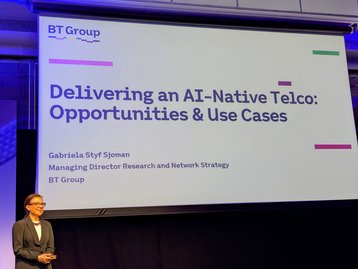
“The reason we don’t have a platform for these models is because every service we launch takes two years, and it’s just so expensive. Imagine a network that allows us to truly innovate on top of the network,” said Styf Sjöman.
Aduna and APIs
Without Vonage on show, Aduna arguably took the role of API wunderkind at the summit, with a more BSS-specific presentation highlighting use cases from the likes of TikTok and Trullio revolving around number verification and know your customer (KYC), a world away from self-healing networks and the like.
Peter Arbitter, chief commercial officer for Aduna, argued that by exposing their network capabilities through APIs, telecom operators can create the new revenue streams envisioned by BT and achieve a return on their infrastructure investments.
The exec also placed the API market opportunity between $7 to $10 billion by 2030, which may make Ericsson happy. Half of the equity venture in Aduna is held by the firm, with the remaining half held in combination by a pool of twelve other telecom leaders.

In conversation with SDxCentral, Arbitter described Vonage as a channel partner of Aduna’s, and clarified the distinction between the pair with Aduna only selling network APIs as opposed to Vonage’s offering of APIs for both networks and communications platform as a service (CPaaS).
“We are not adding any additional intelligence to it,” said Arbitter. “The other ones, like Vonage, are building solutions on top of the API.”
Looking forward to what 5G will bring, the CCO believes network slicing will provide API use cases, but only for low-bandwidth use cases, giving the example of China's Alibaba relying on its own network slice for the last 15 seconds of a transaction to ensure it goes through.
High-bandwidth use cases, he argued, lead directly into net neutrality discussions with European regulators, who would argue internet service providers (ISPs) must treat all internet traffic equally.
Outside of Europe, network slicing, another technology reliant on APIs, may flourish, with commercial deployment at scale better served by autonomous networks.
But Arbitter points to another hurdle. If an operator exclusively reserves, for example, 10% of a cell’s capacity for a specific customer, the remaining 90% must serve everyone else. This can degrade the user experience if the cell is already heavily loaded, and the operator must then decide whether the premium payment of the slice is worth antagonising the main customer base, shouldering all the blame for latency issues.
While autonomous networks can help mitigate this issue by using AI for dynamic rather than static resource allocation, the physical challenge of wireless capacity remains too big a hurdle for software to overcome.
In other words, tomorrow's networks won't be able to solve everything.





Comments