


Nokia recently opened the doors to its "new home of radio" in Oulu, Finland – a campus that houses 3,000 staff working on 5G radio and baseband research, development, and manufacturing.
Construction began in 2022, around 50 years after Nokia first established operations in the city to design radios for the country’s military.
Nokia CEO Justin Hotard and Finnish President Alexander Stubb inaugurated the new site, with a demand for unity: Europe must partner with the U.S. to counter Chinese influence and “high-risk vendors” in critical telecommunications infrastructure.
This geopolitical backdrop adds to the significance of Nokia's Oulu expansion. In an era where 5G networks are seen as national security assets, the campus serves as a statement of European and Western technological independence, a place where Nokia hopes to foster what Hotard called “the AI supercycle.”
SDxCentral got an early look inside the facility, offering a rare glimpse into how one of the world's largest telecom vendors is organizing itself for the next phase of wireless technology and the global competition that comes with it.
A bit about the Oulu campus
Surrounded by a sprawling Finnish forest, Nokia’s new Oulu site spans some 55,000 square meters and contains manufacturing, research and development (R&D), and office space. It even has its own sauna.
The first employees moved into the facility in the first half of this year and are already hard at work, with Nokia touting the factory's tight R&D link helps to ensure product quality.


The site has several anechoic chambers where engineers put Nokia radios through their paces, evaluating electromagnetic compatibilities as well as the ability to function in some of the harshest temperatures.
There are also big efforts at Oulu into 6G tests, with its "drone and sky center" home to ongoing evaluations into technologies for next-generations standards. Engineers there revealed that they had already got a 6G proof of concept (PoC) working at around the 7 GHz frequency band.
There’s also a mammoth data center-esque room where Nokia engineers can simulate an entire nation’s worth of connections. Here, software engineers rigorously test networks to pinpoint vulnerabilities, mimicking performance in both normal and overloaded scenarios, such as high-priority situations like emergency calls from government or police devices.
Beyond pure-play engineering, however, the site itself is as green as the trees that surround it, with the campus running on 100% renewable energy. In addition, additional energy generated from its on-site station is used to heat some 20,000 homes in the nearby city.
From one idea to digital transformation
Chief among the areas SDxCentral got to view was the Smart New Product Introduction (NPI) area. This was essentially a semi-automated factory floor, where human staff would work in tandem with robot arms and small mobile units.
Nokia hosts were keen to stress that while bots were working on its show floor, the production line needed the addition of human workers as the line “needs that brain power.” Among the processes witnessed were an arm-based bot identifying an issue with a product, and a staff member came over to address the issue, with both human and robot working in tandem.
Just as smart as the processes powering its production facility was the line itself, as Nokia revealed that the factory floor routinely gets revised to meet the product pipeline. The floor plan can be revised weekly or monthly to meet certain production needs, with the entire floor tied together via a private network.
Keeping the factory in line is a digital twin, which accurately maps and captures data from more than 160 use cases across the floor.
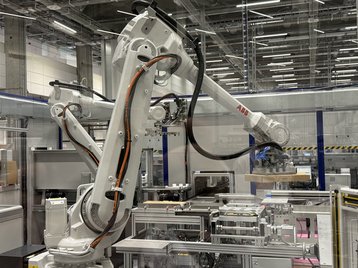
Instead of simply tapping an existing digital twin solution, like Nvidia with its Omniverse platform, Mikko Nissi, who heads Nokia’s Oulu factory, revealed the digital twin was developed in-house using publicly available software tools (though what those were was not disclosed).
The idea to go it alone on the factory floor’s digital twin, Nissi told SDxCentral, came from just “one guy, and has been growing since then.”
That intrapreneurship, where a single employee’s submitted idea became the seed for a full-blown digital twin initiative, is part of a broader employee-driven innovation initiative for the entire campus.
“We have a very low hierarchy. In practice, anyone can propose almost anything, and then we need a bigger group of people to evaluate, discuss, and do the iterations,” Jarkko Pyykkönen, head of Nokia’s Oulu Technology Center, and the company’s lead for supply chain, new products, and technology, told SDxCentral.
“Intelligence is not centralized in my head. It’s among our 3,000 people," Pyykkönen added. "And when we speak about leadership, it’s our task to get those ideas out of those people’s heads and create an environment and atmosphere where they are not afraid to propose something. We need your brain power, and we respect it. We know it’s there, and with people thinking, that’s how we can improve continuously. … It's all about passion and curiosity to do things better.”
The Oulu site is also a global resource for Nokia's worldwide engineering teams. Engineers in Dallas, India, and other locations can remotely access the campus's testing systems and base stations, allowing them to run software tests without traveling to Finland – a setup that reduces both costs and the company's environmental footprint.
Bubbles, drones & dozers
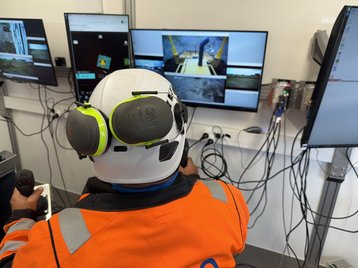
Beyond the campus itself, Nokia’s presence in Oulu extends out to the OuluZone, a testing area it supports some 40 kilometers east of the city.
Spanning some 350-square kilometers, the rural site boasts limited radio frequency interference and traffic, making it ideal for testing next-gen mobile networks. There, SDxCentral got to see up close several projects, including a tactical wireless backbone network, or a “tactical bubble” developed by researchers from Nokia, Bittium, and academic groups.
OuluZone features a racetrack used by on-site engineers for testing in-vehicle connectivity and remote piloting of vehicles, including construction equipment. Researchers from the local university also utilize the site to test autonomous construction machinery. Their SWARM project focuses on developing remote and autonomous control systems for heavy construction equipment, with SDxCentral observing engineers remotely piloting excavators.
Drones were also in operation at the OuluZone, remotely flown by an operator located at Nokia’s nearby Over The Air Validation Area (OTAVA) site. In addition to remote drone pilots, the OTAVA facility is home to anechoic chambers where the firm tests its massive multiple-input, multiple-output (MIMO) and beam-forming technologies.





Comments