


Move over OpenAI, as you’re the Woody to the neocloud’s Buzz Lightyear, and the industry doesn’t want to play with you anymore – at least in the sense that you’re the next big thing. While Sam Altman and co were once held aloft to infinity, the tech space is looking beyond, in a manner akin to the distracted boyfriend meme, except in place of an attractive stock image model is anyone from CoreWeave to Lambda, Nebius to Nscale.
Mordor Intelligence put the neocloud market size in 2026 at an estimated $35.22 billion, up from $24.07 billion a year prior. ABI Research, meanwhile, suggests that inference workloads will account for 80% of the neocloud market by 2030. And Synergy Research Group data that while neocloud revenues are forecasted to reach almost $180 billion by the end of the decade, they’re already eating into the big three cloud providers’ market share today.
It’s a long way to the top then, as JLL research notes that neoclouds witnessed 82% compound annual growth rates in revenue since 2021, with many of them pivoting from the heyday of cryptomining to take advantage of the next big, and largely lucrative thing.
So while the hyperscalers will continue to carry everything and everyone, from storage to website, databases to IoT, neoclouds are narrow and ruthless, offering GPU‑as‑a‑service and AI first, everything else second. These emerging players have sought to rip up the cloud market rulebook, undercutting hyperscalers with cheaper services. Take Akamai Technologies, which claims to offer cloud services up to two-thirds cheaper than the hyperscalers when it comes to compute GPU resources.
But while they’re busy raking in tens of billions of dollars as a result, there’s another, altogether overlooked market trend taking shape beyond disrupting the ruling cloud class. For the neoclouds are reshaping networking in ways almost as fast as AI itself.

SDxCentral Magazine - Issue 1
Debut magazine launches at the Xcelerated Compute Show
The new normal
While data on actual neocloud network usage is somewhat sparse, given their entry into the market, from what we do have, it’s clear there’s a fundamental shift.
Figures from Backblaze’s quarterly "Network Stats" analysis covering the last quarter of 2025 reveal that AI-related data transfers were largely concentrated in the "US East" region, near neocloud compute hubs like Northern Virginia, New York, and Atlanta, with neocloud activity skewed more toward the East Coast, where dense AI compute availability is more widespread.
That aligns true when you consider that CoreWeave, for example, supports workloads in New Jersey, while Lambda is setting up shop in Chicago and Atlanta courtesy of two facilities being built by EdgeConneX.
“From a performance standpoint, this makes sense,” Backblaze technical lead network engineer Brent Nowak explained. “It’s important to keep latency lower to achieve consistent high bandwidth rates for AI data transfers.
“Latency plays a role when you're talking about big data transfers. So if you are having GPU availability on the West Coast, but your data is stored on the East Coast, you obviously have many miles to get through to transfer data. So we're seeing a concentration where East Coast has been the preference so far.”
But that concentration won’t always be the case, as the neoclouds themselves are looking further afield. Nscale, for example, is looking at Europe. It already has a site in Kvandal, Norway, of which OpenAI already rents space, but is looking at sites in Britain, including a facility set to be located in Loughton, Essex. That’s as part of the European leg of OpenAI’s Stargate buildout, with Nokia in line to provide it with networking technologies.
But in the U.S., these players are increasingly looking beyond heavily concentrated markets to take advantage of better access to power and fiber, and of course, talent and taxes. Crusoe is building in Wyoming and Texas, and is even working on plans for modular iterations of so-called AI factories that can be deployed at “virtually any location.”
BluSky AI is leasing sites in Nevada and Utah. CoreWeave already holds space in Applied Digital’s site in Ellendale, North Dakota. And Nebius has secured space in Missouri. This geographic expansion is tied to the fact that, unlike their hyperscale rivals, neoclouds are inherently agile, with their business relying on and setting up shop quickly and efficiently.
But beyond geography, neoclouds are impacting the actual network workloads themselves.
Where traditional cloud players handle a real mix of workloads resulting in an array of outputs, neocloud-related traffic is showing to be AI-centric, and as a result, is changing how workloads are handled.
Backblaze’s findings reveal that neocloud networks often involve fewer, more sizable datasets moving in short, sustained bursts across persistent endpoints and pipelines.
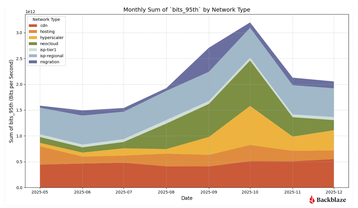

“This contrast reveals a broader trend: AI networking is less about many-to-many communication and more about sustained high-throughput relationships between specialized systems,” Nowak said.
As a result of the neocloud workload inversion, storage, compute, and networking look to be coming together into closer alignment, with emerging operators leveraging tools like Vast Data’s Nvidia-based AI architecture for embedding storage and database processing services directly into AI servers, or Backblaze’s own B2 Neo providing dedicated storage layer for handling the sizable datasets and high-throughput workloads typically seen by such players.
Ciena’s ‘neoscalers’
Beyond being keen, mean, fast-growing AI infrastructure machines, neoclouds are now at a point where they’re starting to see the value in controlling their own high-performance networks.
Among the firms looking to help these emerging players build out their own capabilities is the optical networking and high-speed connectivity giant, Ciena.
As Mark Bieberich, the vendor’s VP of portfolio marketing, put it, this “emerging class of service provider” is increasingly finding that the scale of their AI business – and the need to keep GPUs fully fed – makes actually owning and operating parts of their network worth the capex.
Ciena’s own parlance refers to neoclouds as ‘neoscalers,’ though, based on in reference to the traffic patterns identified by Backblaze’s findings, Bieberich likens them to “mini‑hyperscalers,” in that they borrow many of the same distributed AI and optical network design patterns, but on a smaller – and often much more agile – footprint, frequently stitched together from carrier‑neutral colo sites and managed optical services.
Bieberich outlined to SDxCentral that the top-tier ‘neoscalers’ are sufficiently well capitalized to justify owning and operating their own optical infrastructure, at least in their core corridors. Smaller players, by contrast, lean heavily on wavelength services and managed optical fiber to get to market fast, only contemplating their own network builds once the business has scaled.
“For the middle and smaller players, you probably see more of a mix of services from wholesalers or from telcos to get them operationalized fast, to get them the capacity they need, fast,” the VP said. “Once they reach a certain level of scale in their business, then they start to weigh the alternative of building their own.”
Bieberich added that neocloud network planning and engineering teams are often “quite lean,” and that “they're coming to us, you know, for guidance and expertise around how to build and operate the network that supports their business.”
From a physical infrastructure standpoint, the VP said, “They have to navigate challenges related to fiber scarcity. For example, not all of these players can get ready access to fiber; there, very clearly, is a constraint with respect to fiber availability for a lot of these players.”
Because their business lives or dies on GPU performance, Bieberich stressed that for neoclouds, the network “can't be a bottleneck,” adding: “They need a level of network design and operations and deployment expertise that you know gets them to a high-performing service model.”
Looking ahead, Bieberich suggested that some of the top neoscalers may make the transition to “full-fledged global hyperscaler powerhouses.”
But only time, of course, will tell. It’s still early days, and the ‘neo’ modifier of the term neocloud (or scaler) is still firmly affixed for many of these players.
But if the surging demand for AI inference is anything to go by, they’ll be around, and very well off if they build out their networks right.
This article first appeared in the SDxCentral Magazine Issue #1
Comments