


It’s not often you can spend decades in an industry and have things stay the same, but that’s the story for Soni Jiandani and Ethernet. From her salad days at Ungermann-Bass (UB) Networks to helping grow Cisco’s multibillion-dollar modular switch business all the way to co-founding a company sold to AMD for a cool $1.9 billion, Ethernet has been that constant companion.
By no means the same beast technologically following evolution after evolution, but what has remained the same for Ethernet is openness and interoperability: concepts that Jiandani is now a champion of in her role at AMD.
Where a certain green-colored rival proudly bills itself as being “the largest networking company in the world,” Jiandani and the team at AMD are just as hungry, but taking that drive and honing a more open, systems-level approach with Ethernet at the center.
“There’s no single company that owns the networking landscape in the AI arena,” Jiandani told SDxCentral. “AI infrastructure is just too large and complex for one size or one vendor to make it fit in all forms and shapes.”
She described AMD’s approach as community building, creating an “ecosystem” spanning multiple industry groups across both scale-up networks (inside the rack) and scale-out (rack-to-rack).
But for the copious consortium acronyms that she and her team find themselves having to remember, that one continued constant is, again, Ethernet. UALink over Ethernet (UALoE) offers improved resilience characteristics. And Ethernet for scale-up networking (ESUN) brings improved throughput through targeted optimizations. All of those standards-based evolutions are key in Jiandani’s view as they bring operational process cadence, familiarity, and consistency that customers have long been used to with Ethernet, while having the means to build high-performance networks capable of meeting the needs of AI.
Like Jiandani’s personal story, innovation architectures and designs that have been around for decades are evolving ever more rapidly because of AI, with her noting: “It’s happening at least three- or four-times faster than I have seen on the other side during my pre-AI days.”
In a sense, though, the exec’s path to a company that prides itself on openness and commonality is almost at odds with a career that saw her building the kind of tightly integrated stack she now finds herself positioning against. For two decades, she was the one convincing the market that Cisco’s closed, vertically integrated stacks were the smart bet. Only now Jiandani is doing the opposite for AMD.
In her words, the “foundational nucleus element” between both her time at Cisco and with AMD was, you guessed it, Ethernet.
“You never bet against Ethernet,” Jiandani said. “The beauty about Ethernet is that the Ethernet from four decades compared to three decades to two decades to one decade to now are very different. It continues to evolve.”
She continues: “The other common element is multiprotocol; the ability to take an agnostic approach that what rides on top of that Ethernet transport ought to be multiprotocol in nature. At Cisco, we did innovations while allowing for industry-standard evolutions to occur in parallel. Think about the same way here: the protocols we [AMD] support on Ethernet … support multipathing, driving a lower total cost of ownership for customers like OpenAI, Oracle, and Microsoft.”
Programmability as the moat
If the moat at Jiandani’s former employer, Cisco, is its vast partner network and even more massive existing install base, what does her current employer have? Nvidia boasts tight integration with proprietary hardware, for example.
The AMD exec admitted: “Programmability is a baseline architectural element. It’s our moat, so to speak.”
AMD’s networking offers to truly entrench that idea of programmability, leaning on architectural nous it obtained through purchasing the Jiandani-co-founded Pensando as well as the acquisition of Xilinx. Where Pensando provided the high-speed, processor-driven software programmability element, the Xilinx heritage brought hardware-level adaptivity through its field-programmable gate arrays (FPGAs) and later Versal chiplets.
Having a fully programmable pipeline allows the chip giant’s networking team to not only keep pace with Ethernet evolution but also define it.
“Even when speeds are going up and not coinciding with the evolution of those protocols, I can just … write a P4 program, adapt to the evolving standard,” she said. “I don’t tell my customers, ‘wait for the next silicon while I burn the new gates for that new enhancement in the protocol,’ because the evolution of AI workloads is so fast. You need that capability.”
The philosophy of having networking devices built atop foundational, programmable architectures ties right back into her view that no one company can go it alone when it comes to ruling the AI infrastructure roost. Instead, Jiandani argues it provides the opportunity to partner with both customers and the channel community more effectively, “and innovate at the speed of what I call AI.”
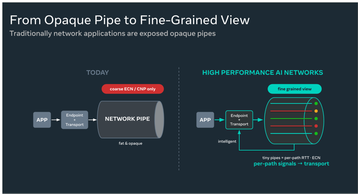

That philosophy isn’t hypothetical, as less than 24 hours before this interview, AMD’s role in helping Meta build its own custom transport protocol, MetaRoCE, came to light. Underpinning it was the same programmable pipeline that let Jiandani’s team co-develop multipath reliable connection (MRC) with OpenAI and others. Two hyperscalers, two bespoke transport layers, both built on the same underlying silicon, making for a quiet rebuttal to the idea that “open” and “custom” are opposites. In Jiandani’s telling, programmability is precisely what lets AMD do both at once.
Chips down on collaboration, not a single technology
Perhaps the biggest change to networking in Jiandani’s career may yet be on the way through optical interconnects. The days of copper aren’t limited by any means but are set to be complemented by silicon photonics, using light to transmit and process data at speeds traditional interconnects could only dream of.
AMD is set to join the optical connectivity party in 2027 through its Instinct MI500. Information about what that would look like is thin on the ground at the time of writing, and Jiandani stood firm, opting not to get ahead of AMD’s own roadmap disclosure.
What she did say, however, was that optical technologies will play an important role in AI infrastructure as it scales.
“We have always maintained that in increasing the bandwidth, allowing for larger scale-up domains, and not just to play a role in optical across racks, but also even within the rack.”
AMD’s approach to that next evolution of the networking stack takes it back once again to the open and interoperable stance we’ve heard so much about. The company was a founding member of the Optical Compute Interconnect Multi-Source Agreement consortium, or OCI-MSA, working on interoperable open standards for optical interconnects for scale-up networks. But instead of racing toward the next big thing, Jiandani described the shift to optical connectivity as less of a leap and more of a “phased transition.”
“We don’t think one day the world is electrical, then tomorrow it’s going to be optical … the company has put a stake in the ground at advancing AI [but], stay tuned; more details to be revealed,” Jiandani said.
More generally on the move toward optics and next-generation networking, Jiandani stressed a focus on getting the basics right: focusing on delivering reliability and performance rates across each level of bandwidth rather than forcing customers to wait once they make hefty upgrades.
“The evolution of applications and the appetite of our customers is such that you have to have a programmable infrastructure that can not only keep evolving in terms of speeds and feeds, but can give you programmability at its underlying architecture,” she said. “You’re not telling the customer, I can give you this functionality on 800G (800 Gb/s), but for 1.6T (1.6 Tb/s) functionality, you need to wait. You can continue to innovate.”
Asked to bet on what actually moves the needle first – optics, open scale-up standards, or software-defined rack scale intelligence – Jiandani declined to pick a lane, pointing instead to programmability and industry collaboration as the real constants.
“Collaboration across the industry is more important than ever before. If there’s one thing that we can do and do faster, [it] is to continue to collaborate and move faster because that is what the market is expecting of us and is expected of every player in the AI space. It’s moving so fast.”
A fitting note then to end on for an executive who’s spent more than four decades betting on Ethernet’s ability to keep reinventing itself without breaking what came before.
This article first appeared in SDxCentral Magazine Issue #2
Comments