


The U.S. was initially an outlier with 5G – will 6G be different? The U.S. took a distinct approach to 5G, emphasizing millimeter wave (mmWave)-based small-cell deployments rather than wide-area coverage in new spectrum. With the industry sentiment regarding the role of 6G shifting over the past year from if to how and when as consensus is accepting that the 6G train is moving forward at full speed, one of the key questions now is if the decision to allocate the entire 1,200-megahertz of spectrum in the 6 GHz band for unlicensed use could impact the 6G roadmap.
One notable shift over the past year has been a change in industry sentiment regarding the role of 6G. The inability of 4G and 5G to reverse the largely flat wireless carrier revenue, taken together with slowing mobile data traffic growth, initially fueled skepticism about the near-term justification for another generational upgrade. The shift in attitude reflects a variety of factors, including changing uplink/downlink ratios with existing devices, a more favorable outlook about growth prospects beyond the smartphone, and evolving end-user requirements.
There is growing evidence that uplink/downlink traffic ratios are slowly shifting, bolstering projections for mobile traffic that suggest operators need to boost capacity by the end of this decade. Moreover, the smartphone remains the dominant communication device today, but the likelihood of a new device emerging that could significantly change traffic patterns and capacity requirements is rising (still low, but increasing), suggesting that 30-gigabytes of monthly smartphone data consumption, driven by limited video usage, might not be the end of the story.
While smart glasses are not yet ready for mass adoption, more operators are increasingly considering the possibility that we are moving toward an environment in which more data is continuously recorded, analyzed, and uploaded throughout the day. And while human consumption of video is inherently constrained, machine-generated traffic is not. As a result, the challenge is no longer just about adding more capacity – it is also about accommodating different types of capacity and fundamentally different traffic patterns.
This shift, combined with the continued scarcity of spectrum, underpins a more constructive outlook on 6G. To be clear, substantial skepticism remains around the return on investment, the viability of new use cases, and the ability to command any meaningful premium with a 6G logo. That said, the narrative is evolving. A growing number of operators now view a next-generation transition as unavoidable, and while marketing will inevitably play a role, there is increasing conviction that both the network and the underlying architecture must evolve to support these emerging demands.
Large contiguous spectrum blocks that can be deployed on the existing site grid are essential for delivering substantial capacity and radio access network (RAN) economic benefits. This is because in a cellular network, operators at a high level only have three tools to improve the overall cellular capacity: spectral efficiency, bandwidth, and cells/sectors.
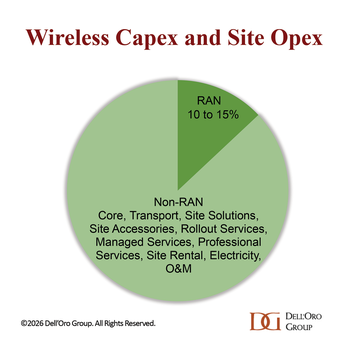
AI and 6G will improve efficiency gains, but the upside will remain limited, possibly in the 10% to 50% range. Since the RAN comprises less than 15% of the overall wireless capex and recurring site opex over the life of the cell site, the economics fall apart if a significant number of new sites are needed to realize equivalent coverage. This ultimately means that wider-spectrum channels will be the primary vehicle for expanding capacity and reducing the cost-per-bit in 6G.

What are the options to realize new 200-megahertz or 400-megahertz channels? Although it is unlikely the 6G anchor band will be as harmonized as the C-Band was with 5G, there is momentum building around the 6.4 to 8.4 GHz range. Since higher-frequency bands translate to greater propagation losses (according to the Hata model for a medium-sized city, the received power drops by approximately 7 dB when comparing the 6 GHz band with the C-Band), continued massive multiple-input, multiple-output (MIMO) and beamforming advancements will be indispensable for achieving equivalent coverage in the upper mid-band.
Suppliers and operators are currently exploring configurations such as 128-transmit/128-receive (128TR) utilizing 768 antenna elements. Though it is still early days, preliminary testing shows promise for both the uplink and downlink. Huawei has verified in small-scale tests that the propagation delta between the 6 GHz and C-Band is manageable with higher-order MIMO. Nokia recently shared results from initial pilots suggesting the upper 6 GHz spectrum could realize 75% of the C-Band uplink throughput gain.

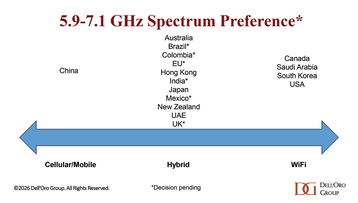
While technological advances will likely mitigate the inherent propagation challenges associated with higher-frequency spectrum, it remains unclear whether policymakers will converge on a common set of trade-offs – particularly with respect to the upper 6 GHz band. Today, approaches vary widely, with some countries favoring a cellular-centric allocation strategy while others argue that opening the entire band for unlicensed Wi-Fi use is more appropriate. A potential middle ground lies between these two extremes, with the lower portion of the band (5.9–6.4 GHz) allocated for unlicensed use and the upper portion (6.4–7.1 GHz) designated for mobile services.
Optimizing spectrum allocation between licensed and unlicensed use is far from straightforward. Wi-Fi proponents can point out that mobile accounted for just 34% of total combined mobile and fixed network traffic in 2025 (Ericsson Mobility Report). Given the congestion challenges in the existing unlicensed 2.4 GHz and 5 GHz bands, expanding access to unlicensed spectrum offers clear near-term consumer and economic benefits.
At the same time, mobile proponents argue that even if mobile traffic growth is moderating and current spectrum holdings are sufficient to support today’s use cases, future network requirements may evolve. Shifts in downlink-to-uplink traffic ratios, along with the emergence of new devices and usage patterns, could materially change how, when, and where mobile data is consumed. From this perspective, the 6 GHz band represents the most realistic opportunity to secure wide-area licensed spectrum capable of supporting very large channel bandwidths without requiring a fundamentally new site grid.
Both sides can credibly argue that significant economic value is at stake. However, the real question is about opportunity cost – not only in the near term, but over the next decade and beyond. If mobile data traffic growth continues to slow, there is a cost associated with allocating too much of the 6 GHz band to licensed mobile use. Conversely, if today’s smartphone-driven demand is not the end of the story and mobile networks ultimately play a pivotal role in the AI era, allocating too much spectrum to unlicensed Wi-Fi could carry a meaningful opportunity cost.
No one knows what the world will look like 10 years from now. That uncertainty is precisely why it is striking that the risk profiles of these policy decisions vary so widely across markets. The only thing we can say with confidence is that not everyone will be right. For now, most countries appear to be gravitating toward a hybrid approach. The U.S., however, once again looks set to become an outlier in the 6G era – albeit with more company this time around.




Comments