


Network and security teams have never had more insight into their infrastructure. Today, they have access to more telemetry, more dashboards, and more alerts than at any point in history.
But visibility has a ceiling. Today's tools capture what has happened and fragments of what is happening right now. What they cannot provide is a complete, provable understanding of network behavior across the entire estate. How traffic can actually flow, which paths are possible, and where risk is hiding in the gaps between what is observed and what is real.
Without that, teams are left to bridge the gaps with experience, intuition, and too often, guesswork. And as AI accelerates the pace of change, that gap becomes a reckoning.
The consequences are not theoretical. Without a mathematically accurate understanding of how the network behaves, every operational decision carries hidden risk. Changes that look safe on paper interact with configurations teams didn't know existed. Access lists drift from the original intent of the policies they were meant to enforce. Teams are left reacting, reconstructing events from logs and flows after the fact, with no true end-to-end understanding of what their network is actually doing. For any organization where the network is critical, that is not an operational inconvenience. It is exposure.
AI changes the calculus entirely. As organizations begin to deploy AI-driven automation in their operations, the tolerance for ambiguity drops to zero. AI agents acting on incomplete or approximate knowledge of the network do not pause to apply experience or intuition. They act. And when the foundation they are acting on is uncertain, the blast radius of a wrong decision is not human scale, it is machine scale. The operational gap that teams have managed through care and expertise for years becomes, in an AI-driven environment, a structural risk.
The foundation that changes everything
The answer is not more visibility. It is a more accurate understanding of how the network behaves.
A network digital twin is a living, continuously updated model of your network's behavior as it actually exists. Not as it was documented, not as it was last observed, but as it is configured and operating right now, across the entire estate. Critically, this model is not just descriptive. It is computed from the actual state of the network, giving teams the ground truth they have never had before.
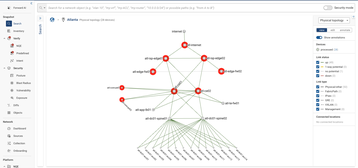
But not all digital twins are equal. Some reduce the network to an observed, normalized view of configuration, lacking the ability to model how traffic actually flows end-to-end; others rely on virtual replicas of individual devices, which cannot represent the full system at production scale. Neither approach delivers an outcome you can trust. A true network digital twin is built from the actual configuration and state of every device across the estate, and computes outcomes deterministically. Not how the network might behave. How it will behave
That ground truth is what allows teams to answer questions that today require guesswork. What paths are actually available between two points? Where do dependencies exist across hybrid and multi-cloud infrastructure? Has configuration drifted from design intent? Where are security policies creating exposure? These are not edge case questions. They are the questions that determine whether operations run with confidence or with risk.
And the ground truth is exactly what AI needs to operate reliably on your network.
What becomes possible
When organizations close that gap, the shift in how teams operate is immediate and tangible.
Troubleshooting that once took hours of reconstruction takes minutes. Changes that once required layers of manual validation can be verified instantly against a mathematically accurate model of the network. Security posture stops being a periodic assessment and becomes a continuously verifiable state. Teams stop reacting and start operating with genuine confidence.
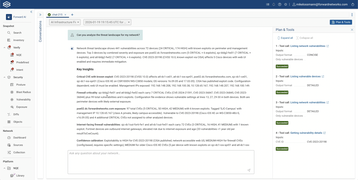


But that is only the beginning of what this foundation makes possible.
When AI systems have access to ground truth, they can do more than assist. They can begin to take on operational tasks with the kind of certainty that makes autonomy responsible rather than reckless. Not AI operating on approximations and inference, but AI operating on a complete, accurate, mathematically grounded understanding of the network as it actually exists.
That is the shift from confident operations to autonomous operations. And the organizations building toward that future are starting by closing the gap that has always held them back.
The question is not whether that shift is coming. It is whether your foundation is ready for it.
Comments