


In a mission-critical industrial environment, a single dropped packet can trigger a safety shutdown that costs thousands of dollars per minute. Applications such as autonomous mobile robots (AMRs), remote-controlled cranes, or synchronized manufacturing cells demand sub-millisecond end-to-end latency combined with near-perfect uptime.
Modern factories are making the transition from wired Ethernet cabling to flexible private 5G networks. However, wireless networks can have unpredictable performance due to radio frequency (RF) interference that can occur in areas with heavy machinery, moving metal containers, structural steel, and competing wireless frequencies. While private 5G networks leverage time-sensitive networking to guarantee latency, ensuring zero-packet-loss over the air requires a different tool.
Moving beyond simple determinism
Industry-standard time-sensitive networking capabilities in private 5G networks make it possible for wireless networks to prioritize packets and ensure the required latency for mission-critical systems, which often operate under very tight one-to-15 millisecond end-to-end latency constraints.
While time-sensitive networking standards provide bounded low latency, synchronization, and traffic management, there is a need for additional data packet reliability to achieve zero-packet-loss reliability. Time-sensitive networking is inherently a deterministic framework that relies on a single optimal path, making it vulnerable to wireless interference, physical obstructions, or sudden disconnections on the factory floor.
Filling that gap is frame replication and elimination for reliability (FRER). This standard (IEEE 802.1CB-2017) brings the capability for redundant data transmissions. This redundancy achieves zero-loss, seamless redundant network paths with zero switchover time. This brings to private 5G the end-to-end service determinism that is traditionally expected in a carrier-grade network.
How does FRER work?
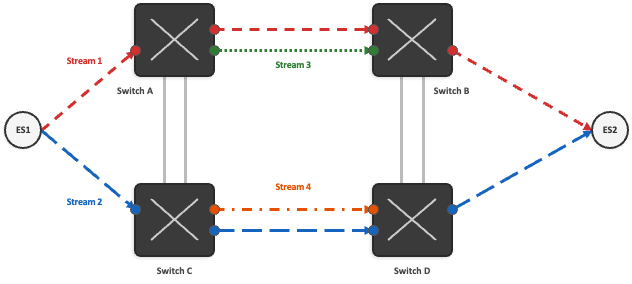
FRER works by adding two new network elements called end systems (ES) to a wireless network. The ES1 (the source/talker end system) is deployed at the network ingress. The ES1 tags each packet in a data flow with a redundancy tag (r-tag), which includes a sequence number for that data flow.
These packets are then replicated and are forwarded to several redundant and disjoint network pathways called member streams that all lead to the destination where the ES2 is located.
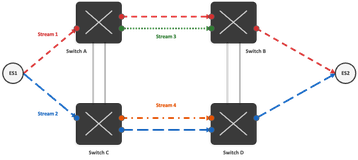
Just before the network egress is the ES2 (the listener end system), which provides a monitoring and recovery function that detects these frames.
At ES2, the member streams converge at the FRER recovery function. The ES2 uses the r-tag sequence number to identify duplicates, accepts the first valid in-sequence frame, and discards subsequent copies. This process can be seen in Figure 1, where multiple streams are shown taking unique paths throughout the network.
The mechanism relies on multiple packet copies of the same sequence arriving from different paths (e.g., across distinct wireless frequencies or separate physical routers). Because ES2 does not wait for a failure indication or perform a control plane switchover, delivery is effectively hitless – if one path drops or delays a frame, another copy is accepted with zero failover time.
Anatomy of the redundancy tag (r-tag)
To understand how FRER avoids latency penalties during a failure, look at the packet level. When the ES1 ingress system intercepts an incoming standard Ethernet packet, it modifies the packet by inserting a six-byte redundancy tag (r-tag) directly before the payload. This r-tag contains a critical two-byte sequence number alongside a flow identifier.
Because the sequence number is hardcoded into the packet, the downstream ES2 egress system doesn't need to perform complex algorithmic calculations or wait for a timeout window to expire to detect a dropped link. It simply looks at its tracking registry. For example, if it has already processed sequence number 0042 from the "red" path, and an identical sequence number 0042 arrives a microsecond later from the "blue" path, the ES2 discards the duplicate at the hardware layer. If the red path fails entirely, the blue path packet is seamlessly passed through without a single millisecond of control-plane negotiation.
Key takeaways
FRER is one of the most critical solutions for ensuring service reliability in mission-critical industrial production control environments. It can be implemented in actual deployments based on heterogeneous network architectures such as 5G and Wi-Fi, 5G and wired, or 5G dual-band setups.
The FRER redundancy transmission mechanism drastically improves the success rate of end-to-end traffic data transmission, ensuring the reliability of accurate data transmission and reception. This provides deterministic service guarantees – such as predictable delay, reliability, and high availability – in business-to-business industrial application scenarios. FRER is therefore a complete, service-based high-reliability solution for the future of industrial wireless networking.





Comments