

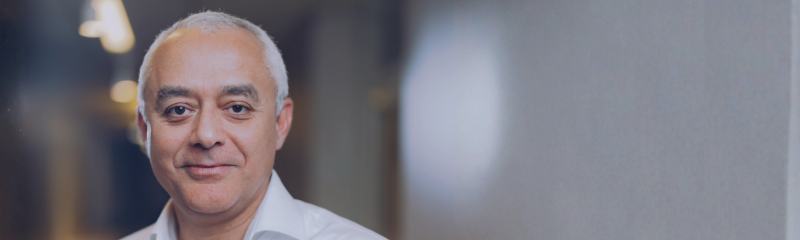
Khaled Maalej, CEO of Vsora, put the French inference chip maker’s success down to premium memory and packaging through close ties with Taiwan, offering a European product devoid of American supply.
In conversation with SDxCentral, Maalej claimed to be the only European alternative to Nvidia and AMD, if not “the one big player when it comes to inference.”
The CEO highlighted that Vsora’s flagship Jotunn8 is a rare example of a European chip leveraging HBM3E (High Bandwidth Memory 3 Extended), saying “we are probably the only company in Europe having access to HBM3E today.”
That high-bandwidth memory (HBM) capability is packaged alongside the AI accelerator die in the same package, thanks to chip-on-wafer-on-substrate (CoWoS). Taiwan Semiconductor Manufacturing Company Limited (TSMC)'s advanced packaging technology bundles multiple chips very close together on one package.
As the CEO explained, Vsora’s close relationship with TSMC stems from Dibcom, a French chipmaker specializing in digital-TV receiver chips, which Maalej also co-founded. After Maalej sold Dibcom to Parrot SA in 2011, he co-founded Vsora in 2015, initially staying close to Dibcom's heritage: its first business was digital signal processing (DSP) IP for 5G baseband and wireless processing.
“The team was known to execute very well (with Dibcom). This opened paths to our partners, convincing TSMC and the HBM vendors today to give you access to the technology. I think it's a very limited club today in the world having access to this."
From Dibcom to Vsora
Today, Vsora has moved from IP to selling its own silicon. Touting 288 gigabytes of memory and 3.2 petaflop processing power, Jotunn8 is purpose-built to overcome the memory wall, a performance gap between fast processors and relatively slow memory that is one of the main barriers to efficient AI inference. Ultimately, Vsora aims to allow AI to run with significantly lower infrastructure costs and energy consumption.
“Back then, we didn't even know that it was called memory wall,” Maalej recalled. “It took us like two years to put the technology in place, and we started addressing the 5G market, which required the highest processing power, and we started as an IP company. And very quickly people understood a little bit of our architecture, told us we need to look after AI.”
Vsora then approached major German carmakers to evaluate their technology for autonomous driving and, according to Maalej, found their architecture delivered far better processing efficiency and lower latency than competitors. This led to a multi-year collaboration on level‑4 autonomous driving, during which Vsora’s design scaled from 100 teraflops to 1 petaflop by early 2020, with performance about 60% above NVIDIA’s A100 chip.
That success spurred a shift to a full fabless semiconductor model by developing their own silicon with partners like TSMC. By 2022, the team discovered that about 80% of AI token cost comes from paying off the chip itself, meaning the only real way to lower cost per token is to increase silicon throughput as much as possible.
“The market is realizing today that the big market is going to be inference. Today 50% of the processing power in the world of data centers is probably still used for training, 50% for inference. We see that rate going to 90% inference … But still, this growth will not happen if we don't actually reduce the cost per token,” Maalej said.
Vsora and sovereignty
Headquartered in Meudon-La-Forêt, Vsora today has around 70 staff spread across Asia and the Middle East. The firm plans to launch a next-generation chip later this year, and is collaborating with partners on servers and racks to speed time‑to‑market and solve system‑integration issues.
“We remain a silicon vendor. We are not willing to sell systems,” Maalej stressed.
Following a recent fundraising round whose full amount was not disclosed, Vsora aims to expand into the U.S. and has hired as its new chair Sandra Rivera, who previously led Intel’s AI business.
But Maalej stressed Vsora’s sovereign proposition, noting a growing global appetite for “non‑U.S. silicon,” with data center operators in Europe and elsewhere wanting at least 10–20% of their chips from outside the U.S. to reduce dependency and bolster sovereignty.
“Europe will have to have its own silicon. I don't think that we can completely rely on silicon coming from the U.S. because you never know what can happen, and AI is becoming fundamental. I mean, you can see it as like having water or electricity or something equally fundamental.
“Where we (Europe) were standing six months ago is completely different from today. Europe is trying to put in place programs and these kinds of things. But we need to run faster.”


Comments